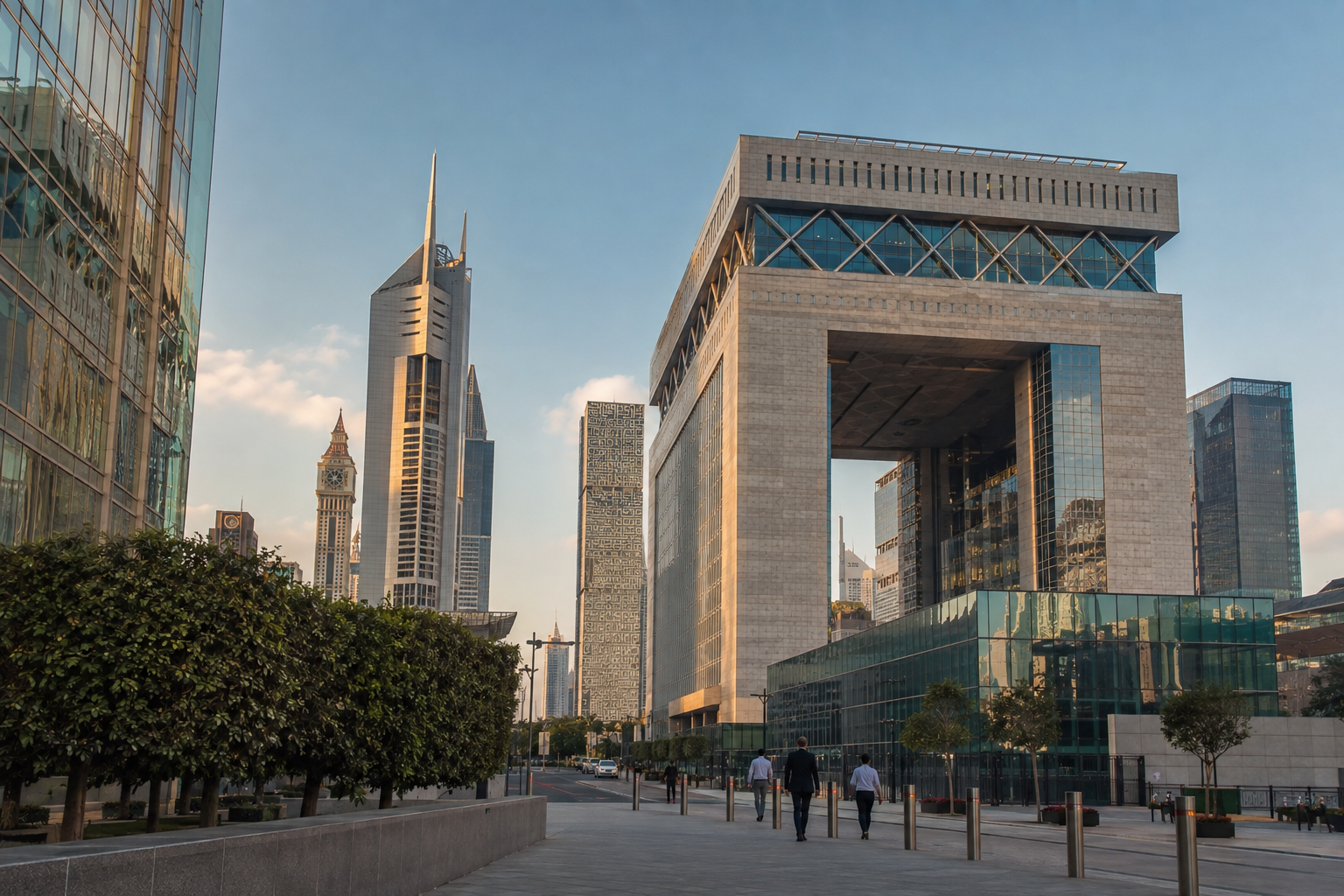
Dubai's DIFC and Abu Dhabi's ADGM both closed the first half of 2026 with numbers most financial centres would put on a billboard. But look past the headline totals and the more interesting story is where each centre is accelerating right now, not where it stands overall. ADGM's fund and asset management ecosystem just had its strongest single quarter on record. DIFC's family wealth structures grew faster than almost anything else in its portfolio. Neither of those facts made the press release headlines. Both matter more for what happens in the second half of the year.
This is a fresh baseline, not a continuation. DIFC and ADGM each report on a first-half and full-year cycle, so H1 2026, covering January through June, is the most current official data set either centre has published. Neither had released third-quarter figures as of this writing. What follows is a straight read of what both centres disclosed themselves, plus the one regulatory change from the period that plausibly explains part of the shift: a sharply lower entry bar for family offices in Abu Dhabi.
DIFC: Foundations and Family Wealth Lead the Pace
DIFC closed H1 2026 with 10,018 active registered companies, the first time the centre has crossed five figures, according to its own H1 2026 results announcement. That is 30 percent organic growth over the prior twelve months, driven by 2,318 new active companies. The pace was front-loaded: DIFC's own Q1 2026 figures show 775 new companies in the first three months alone, a 62 percent jump on the 478 registered in Q1 2025.
The fastest-growing categories by percentage were not the ones DIFC usually leads its press releases with. Foundations rose 67 percent year on year to 1,409. Family-related entities, the vehicles behind single and multi-family offices, grew 36 percent to 1,408. Regulated financial services firms, DIFC's traditional core, grew a comparatively modest 16 percent to 1,134, still the first time that count has passed 1,000. Gulf News's coverage of the announcement noted that new regional offices opened in the period include Citadel, Bank of Canada, JP Morgan International Advisors, and ICICI Prudential Asset Management.
A DIFC Foundation is a low-cost succession and asset-holding vehicle families use ahead of setting up a full family office. A 67 percent jump in foundation registrations is typically a leading indicator: families structure the foundation first, then decide over the following 12 to 24 months whether to staff a full single or multi-family office on top of it. If that pattern holds, DIFC's family-related entity count has further room to run into 2027.
| DIFC metric | H1 2026 | H1 2025 | Change |
|---|---|---|---|
| Active registered companies | 10,018 | n/a (12-mo base) | +30% YoY organic |
| New companies (Q1 2026 alone) | 775 | 478 | +62% YoY |
| Regulated financial services firms | 1,134 | ~978 | +16% YoY |
| AI, fintech and innovation firms | 1,933 | ~1,390 | +39% YoY |
| Family-related entities | 1,408 | ~1,035 | +36% YoY |
| Foundations | 1,409 | ~844 | +67% YoY |
The AI, fintech and innovation cluster also kept expanding, up 39 percent to 1,933 firms after the DIFC Innovation Hub took in 361 new companies during H1. That is the segment most directly tied to Dubai's broader push to position itself as an AI-native financial centre, a transformation DIFC has said it expects to generate roughly 3.5 billion US dollars in economic value and 25,000 jobs over time.
ADGM: The Funds Ecosystem Just Had Its Best Quarter
ADGM's headline H1 2026 numbers, published in its own H1 2026 results and confirmed by the Abu Dhabi Media Office, show assets under management up 54 percent year on year and total active licences reaching 13,974, the largest count of any international financial centre in the Middle East, Africa and South Asia region by that measure.
The number worth sitting with is quieter: ADGM's fund and asset manager count reached 190 in H1 2026, up from 154 a year earlier, a 23 percent annual increase. Of that growth, eleven managers were added in the second quarter alone, which ADGM itself described, in coverage from Economy Middle East, as its strongest quarterly increase. The number of funds managed out of ADGM rose to 276, up 32 percent from 209 a year earlier. Financial services entities overall grew 27 percent to 392.
| ADGM metric | H1 2026 | H1 2025 | Change |
|---|---|---|---|
| Total active licences | 13,974 | n/a (12-mo base) | Record high |
| Assets under management | n/a (index) | n/a (index) | +54% YoY |
| of which added in Q2 2026 alone | 11 | n/a | Strongest quarter on record |
| Funds managed from ADGM | 276 | 209 | +32% YoY |
| Financial services entities | 392 | 308 | +27% YoY |
Q1 2026 alone had already brought 961 new licences and a 57 percent AUM jump, with asset managers establishing in ADGM during the quarter collectively representing over 4.4 trillion US dollars in global assetsunder management. Names entering or expanding during H1 2026 include Capital Group, Man Group, Barings and Bain Capital. The step-change signal in this Ledger is not that ADGM grew, everyone expected that, it is that the growth accelerated quarter on quarter in the specific segment, fund and asset managers, that determines how much institutional capital actually gets deployed out of Abu Dhabi rather than simply registered there.
The Regulatory Driver: Abu Dhabi Lowered the Family Office Bar
One concrete rule change from the period plausibly connects to both centres' family wealth numbers. Under ADGM's Commercial Licensing Regulations (Conditions of Licence and Branch Registration) Rules 2026, which took effect on 24 April 2026, the minimum family net asset threshold for a Single Family Office fell to 10 million US dollars, down from the 30 million US dollar figure that applied under the prior 2024 rules. That change lands squarely inside the second quarter, the same window in which DIFC's foundation and family entity growth was compounding fastest across the border in Dubai.
The two centres are also coordinating directly in one area. ADGM and DIFC jointly launched an Institutional Fund Manager licence category in December 2025, aimed at fund managers managing between 200 million and 1 billion US dollars, a bracket that previously fell awkwardly between each centre's smaller-manager and large-institution licence tiers. It is a small structural detail, but it is the clearest evidence yet that the two free zones see funds infrastructure as a shared regional bet rather than a zero-sum competition between Dubai and Abu Dhabi.
What to Watch Next Quarter
- Whether ADGM's Q2 fund manager pace, 11 in one quarter, holds or was a one-off cluster of large institutional entries.
- Whether DIFC's foundation growth rate cools now that the initial wave of family wealth relocation to the UAE matures into staffed family offices.
- Q3 2026 figures from both centres, expected around October, alongside the broader September MENA capital deployment picture covered in our funding pace analysis.
- Uptake of the joint Institutional Fund Manager licence as a signal of whether the $200 million to $1 billion bracket was genuinely underserved.
For context on where that institutional capital is coming from, see our earlier look at how ADIA built one of the world's most powerful sovereign wealth funds, and our coverage of why the UAE's billionaire population keeps growing. On the Dubai capital markets side, EFG Hermes and DFM's recent investor day is a useful companion read.