When the UAE becomes your launchpad
When Barun Khanal landed in the United Arab Emirates in May 2007, he carried little more than a three-month tourist visa, an MBA in finance, and the kind of quiet determination that most people underestimate on first glance. There were no job offers waiting. No professional contacts to call. Just a city mid-transformation, and a decision to make the most of it.
Nearly two decades later, Khanal serves as Financial Controller for a multinational technology conglomerate, directing commercial strategy, financial governance, and risk management across some of the Gulf's most critical airport infrastructure projects, from Dubai International Airport to King Abdulaziz International Airport in Jeddah.
His story is not unusual among the UAE's vast expatriate professional community. But it is instructive, because it charts exactly how the Emirates rewards those willing to start at the bottom and invest in the long game.
Starting over, step by step
"My professional journey in the UAE was built step by step," Khanal says. "My early years were not glamorous, and it is important to state that honestly. Like many expatriates, I started with simple roles, and each one cultivated the discipline, accountability, and resilience required for corporate leadership."
That first role was a hotel cashier, a starting point that bore little resemblance to the MBA he had earned. But Khanal treated it as the foundation it turned out to be. By 2010, his wife had joined him in Dubai, and the family began building a permanent life in a city that had begun to feel like home.
The pivotal shift came in 2012, when Khanal moved into a structured multinational environment as a commercial administrator. The transition introduced him to corporate rigour at scale: the kind of environment where professional certifications matter, where financial discipline is measured, and where performance opens doors nationality cannot close.
His career ladder, rebuilt over nearly two decades: Hotel Cashier, Sales Coordinator, Project Accountant, Commercial Administrator, Commercial Project Manager, Financial Controller.
The meritocracy argument
"One of the greatest competitive advantages of the UAE workplace is its strict alignment with meritocracy," Khanal notes. "The environment systematically encourages professionalism and ownership. I was never constrained by my nationality or background; instead, the market demonstrated that if you consistently deliver high-quality work, organisational advancement will follow."
It is a case study that resonates with the UAE's broader economic positioning. The country has long attracted professionals from across South Asia, Southeast Asia, Europe, and beyond, not just because of tax-free salaries, but because of the genuine pace of its private sector development. The wider Gulf region is undergoing an infrastructure expansion with few parallels globally, and that expansion demands financial minds capable of managing complexity at scale.
Overseeing the infrastructure of Gulf aviation
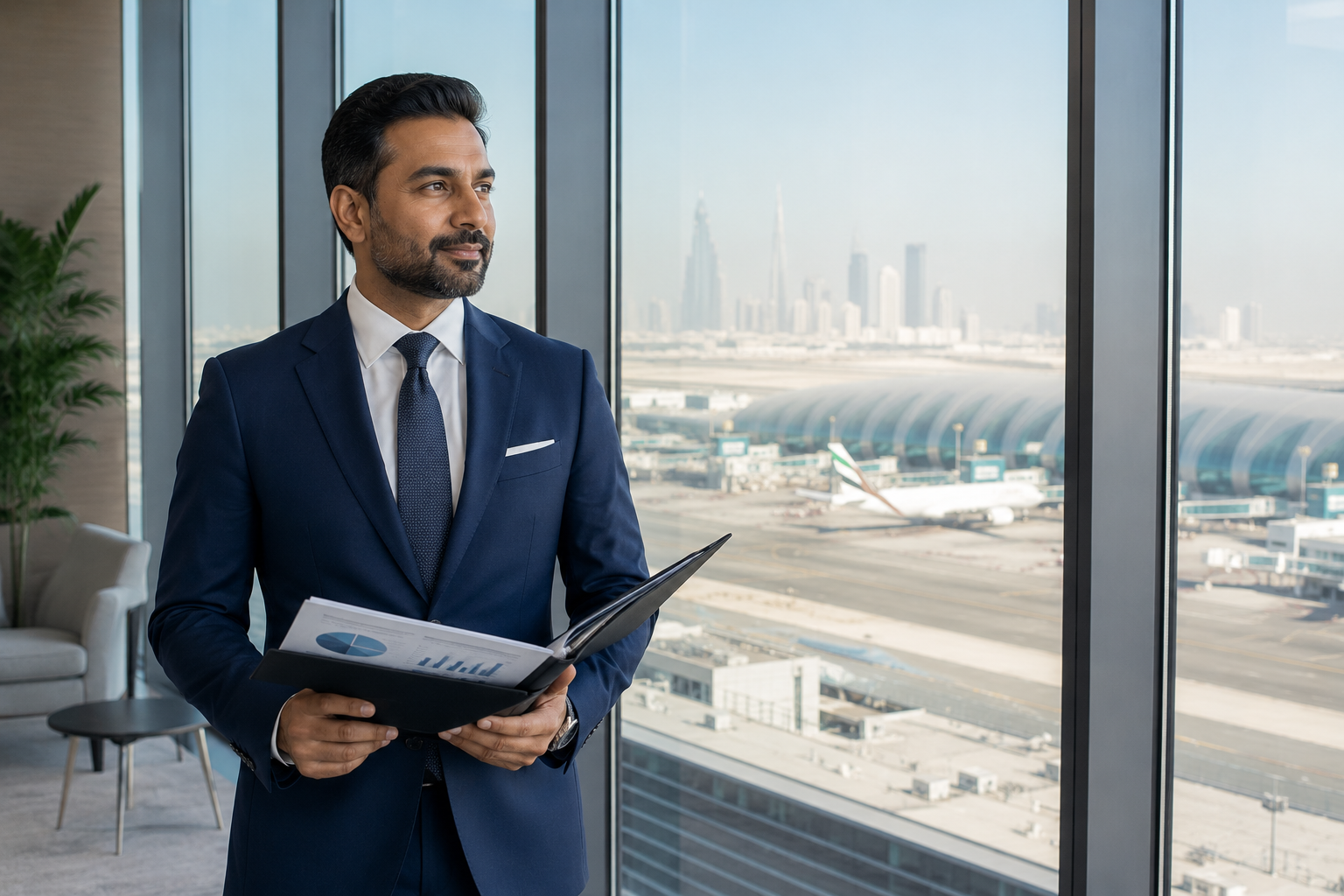
For the bulk of his UAE tenure, Khanal has operated behind the scenes of the region's aviation boom. His work centres on the commercial management and financial oversight of complex airport baggage handling systems, specialist infrastructure that underpins passenger operations at some of the world's busiest airports.
His current portfolio includes financial oversight for projects at: Dubai International Airport (DXB), Abu Dhabi International Airport (AUH), King Khalid International Airport in Riyadh (RUH), and King Abdulaziz International Airport in Jeddah (JED).
His mandate covers budgeting, strategic forecasting, cost control, audit coordination, and end-to-end financial governance across multi-million-dollar contracts. It is the kind of role that is invisible to the travelling public, and entirely essential to everything running on time.
"It is deeply rewarding to know that my fiscal oversight contributes directly to the seamless travel experience of millions of passengers across the region," Khanal reflects. "To play a role in the UAE's macroeconomic growth story is a point of immense professional pride."
Giving back to the next generation
Long-term expat life in the UAE changes a person's relationship with the word "home". For the Khanal family, the UAE's socioeconomic stability, and the quality of education available to their two children, made the decision to stay a permanent one rather than a provisional one.
Beyond his corporate responsibilities, Khanal actively mentors newer arrivals within Nepal's expatriate community in the UAE, offering guidance on career navigation, financial discipline, and the cultural adaptation that formal qualifications rarely prepare anyone for.
His advice is consistent and worth hearing: "Your initial employment contract is merely a starting point, not your permanent professional identity. If you maintain corporate integrity, prioritise continuous learning, and practise patience, the UAE's business ecosystem can elevate your career far beyond your original expectations."
Nineteen years after stepping off a plane with a tourist visa and no plan B, that assessment looks rather well-founded.