Air taxis are coming to Dubai. That's no longer a vision, it's a scheduled reality. But before any passenger climbs into an electric vertical take-off and landing (eVTOL) aircraft over the city, a layer of invisible infrastructure has to be in place. And that infrastructure is now installed.
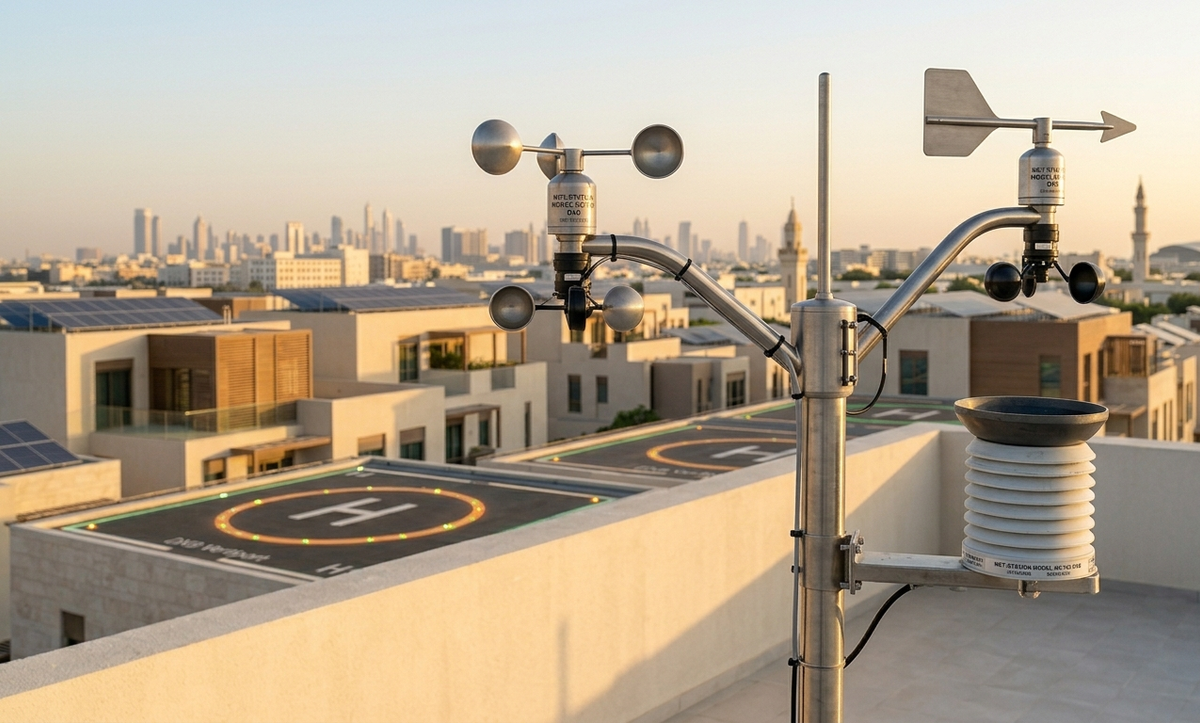
Bayanat Engineering, a leading UAE provider of aviation and critical infrastructure solutions, has announced the deployment of advanced meteorological sensing systems at the DXV vertiport, Dubai's first commercial vertiport, located near Dubai International Airport.
Why Weather Data Is the Backbone of Air Taxi Safety
Unlike commercial aircraft operating at altitude, eVTOL air taxis fly through the most turbulent, unpredictable layer of the atmosphere, the urban boundary layer, just above city buildings. Wind gusts, sudden pressure changes, and reduced visibility can be life-critical events at low altitude.
This is why Bayanat Engineering partnered with Vaisala, a global authority in environmental measurement, to deploy a suite of precision sensors at the DXV vertiport.

An air taxi has far less margin for error than a commercial jet. Real-time, hyper-local weather data at the exact vertiport location isn't a nice-to-have; it's the difference between a safe landing and a catastrophic one.
A Milestone Moment: Including a Royal Visit
The technical completion of DXV isn't just a construction milestone. It drew a visit from Sheikh Hamdan bin Mohammed bin Rashid Al Maktoum, Crown Prince of Dubai and UAE Minister of Defence, a clear signal of how seriously the UAE government is taking urban air mobility as a strategic priority.
Fares Bou Daher, Director of Engineering & Technology at Bayanat Engineering UAE, put the significance plainly:
As Dubai moves to lead the world in commercial eVTOL services, deploying the right meteorological infrastructure is critical. This directly supports Dubai's ambition to become a global hub for sustainable urban air mobility.
Bayanat Engineering's Play in Advanced Air Mobility
The DXV partnership represents Bayanat Engineering's strategic entry into the Advanced Air Mobility (AAM) sector, a market shifting from research to reality faster than most predicted. By partnering with Skyports Infrastructure, the global leader in vertiport development, Bayanat is positioning itself at the centre of the ground-side technology stack that makes eVTOL operations possible.
Elie Hannouche, Group Managing Director of Bayanat Engineering, described the DXV facility's completion as a "defining moment" for global urban air mobility; not just for Dubai, but for the industry as a whole.
The vertiport infrastructure market is nascent but moving fast. Companies establishing ground-side technology partnerships now, weather systems, power, and comms are building defensible positions in a sector that will expand rapidly across global cities.
What Comes Next
With the DXV vertiport technically complete and its meteorological systems operational, Dubai is in the final stages of preparation for what will be a historic first: the launch of the world's first scheduled commercial air taxi service. The emirate's ambition is clear. The infrastructure is real. And the technology is already running.