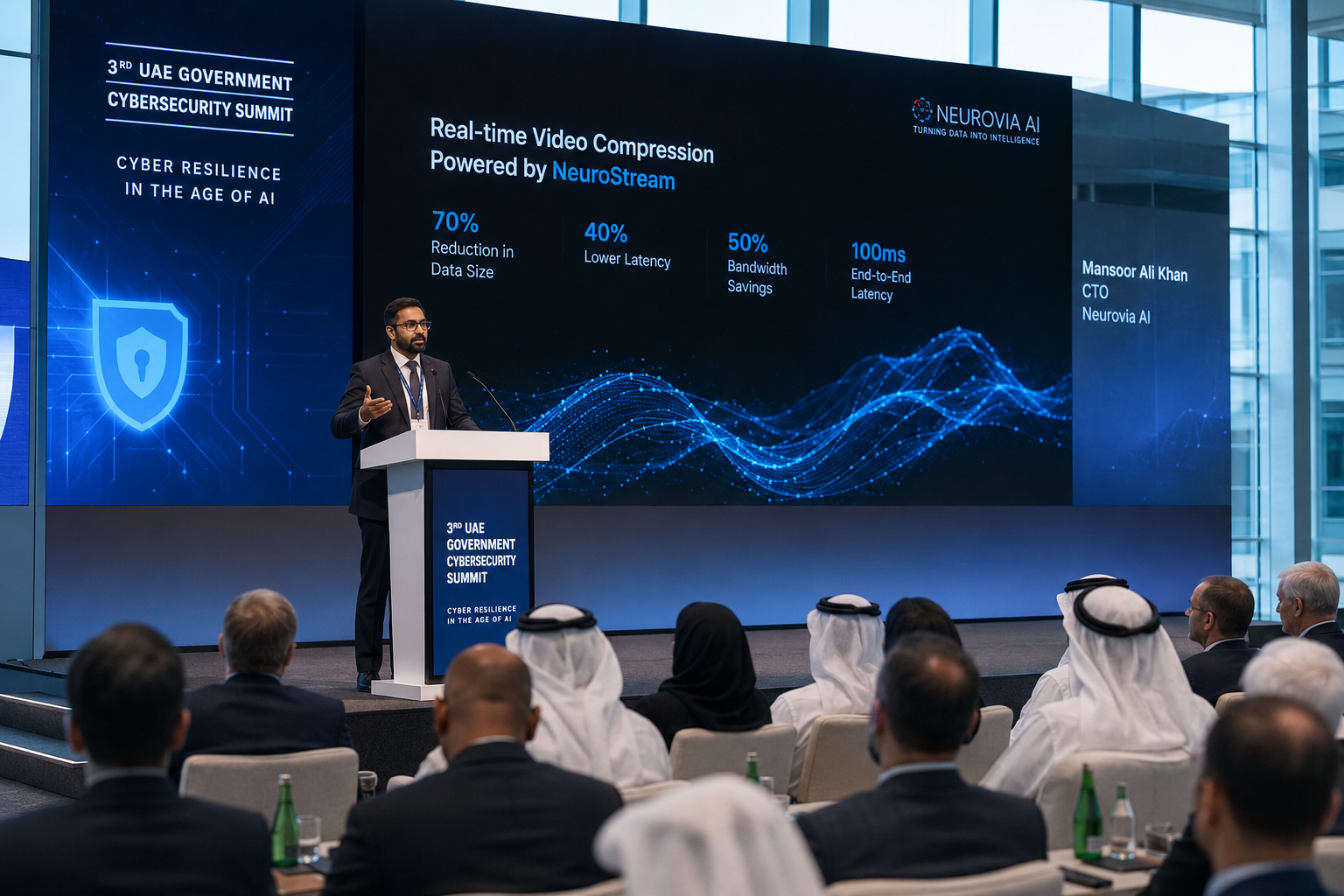
A New Kind of AI Partner Walked Into a Government Summit
Most technology companies arrive at government summits to shake hands and collect business cards. Neurovia AI arrived with a live demo that compressed a 12.15GB 4K video file down to roughly 421MB, a reduction of more than 96%, while keeping the image quality fit for machine vision and AI processing. That kind of performance tends to get attention in a room full of cybersecurity officials.
The company, a wholly owned subsidiary of Robo.ai Inc. (NASDAQ: AIIO), attended the 3rd Government Cybersecurity Summit in Abu Dhabi as its official AI cybersecurity partner. The event brought together government leaders, regulators, and technology professionals to discuss how the UAE can strengthen its digital infrastructure against increasingly sophisticated threats.
What NeuroStream Actually Does
NeuroStream is Neurovia AI's flagship visual data infrastructure platform. It is designed to handle the scale challenge that comes with deploying AI at a national level: the more cameras, sensors, and video feeds you connect to a network, the more storage, bandwidth, and computing power you need.
The platform addresses this through what the company describes as visually lossless compression, meaning machines can still process and interpret the video accurately after compression, even though the file size has dropped by over 96%. For government agencies managing surveillance networks, smart city infrastructure, or autonomous vehicle data pipelines, that kind of efficiency has real financial and operational implications.
NeuroStream compressed a 12.15GB 4K video to 421MB, a 96%+ reduction, while maintaining quality for AI and machine vision workloads.
The platform also supports localized data processing within enterprise firewalls. That matters for government clients because sensitive visual data, whether from public safety systems or national infrastructure, never has to leave a controlled environment. Closed-loop data circulation means fewer points of exposure and simpler compliance with national data sovereignty rules.
The Keynote That Set the Tone
Neurovia AI CTO Mansoor Ali Khan delivered a keynote titled "Building Trusted Visual Intelligence Infrastructure for the AI Era." The presentation walked through why the traditional approach to visual data management is breaking under the weight of modern AI deployments: computing bottlenecks, energy demands, real-time processing requirements, and the data security challenges that come with operating at scale.
The core argument was straightforward. As AI moves deeper into physical environments, the infrastructure supporting it needs to evolve. You cannot bolt next-generation AI onto old data pipes and expect it to work reliably, securely, or affordably.
Read Also: US AI Unicorn Positron AI Picks Dubai for Its First Office Outside America
Who Is This Built For
Neurovia AI is targeting sectors where visual data volumes are growing fast, and infrastructure costs are climbing accordingly. The company lists public safety, smart city operations, autonomous driving programmes, intelligent manufacturing, and large-scale AI infrastructure projects as priority deployment areas.
For the UAE, which is investing heavily across all of those sectors, the timing is deliberate. The country is not just building smart cities as a branding exercise. It is deploying real infrastructure, running real data, and facing real operational decisions about where to store it, how to secure it, and how to keep costs manageable as the volumes grow.
Neurovia AI says it is currently preparing proof of concept deployments with regional partners. Those conversations are at an early stage, but the summit appearance signals that the company is prioritising government and enterprise clients in the Gulf as its primary market.
Why This Matters for the B2B Technology Market
The story here is not just about one company or one platform. It reflects a broader shift in how governments and large enterprises are thinking about AI infrastructure. Buying AI capabilities is one thing. Building the underlying data management layer that makes those capabilities reliable, secure, and cost-efficient at a national scale is a different, harder, and more commercially interesting challenge.
For technology vendors, systems integrators, and enterprise buyers operating in the Gulf, the NeuroStream approach to visual data compression and localized processing represents the kind of foundational layer that procurement teams will increasingly need to evaluate alongside AI software itself.
External context is useful here. The UAE's Cyber Security Council has reported more than 800,000 daily cyberattacks in recent months, underscoring why secure, localized data infrastructure is not a nice-to-have but a national priority.