
There is something worth noticing about what happened in the UAE's fintech sector between January and March 2026: it did not pause.
While geopolitical tension rippled through the broader region and global markets navigated uncertainty, investors kept writing large cheques into UAE-based financial technology companies. According to data from S&P Global Market Intelligence, the UAE attracted US$486 million in fintech funding in Q1 2026, enough to rank it third in the world, behind only the United States and the United Kingdom.
That is not a small number. And the story behind it is more interesting than the headline figure.
What the Money Is Actually Going Toward
This was not a quarter defined by early-stage bets on unproven ideas. The capital that moved in Q1 was largely directed at platforms with real customers, real revenue, and real infrastructure needs. Three themes dominated:
- Infrastructure that can operate at national scale
- B2B finance tools that solve day-to-day SME liquidity problems
- Digital banking built for underserved Muslim-majority markets
That focus tells you something about where UAE fintech is in its maturity curve. The speculative phase, where ideas raise money on the strength of a pitch deck has largely given way to a more institutional mindset. Investors want companies that can plug into existing financial systems, comply with regulators in multiple jurisdictions, and grow without burning through cash.
The Deals That Defined the Quarter
Mal Islamic Digital Bank US$230 million Seed Round
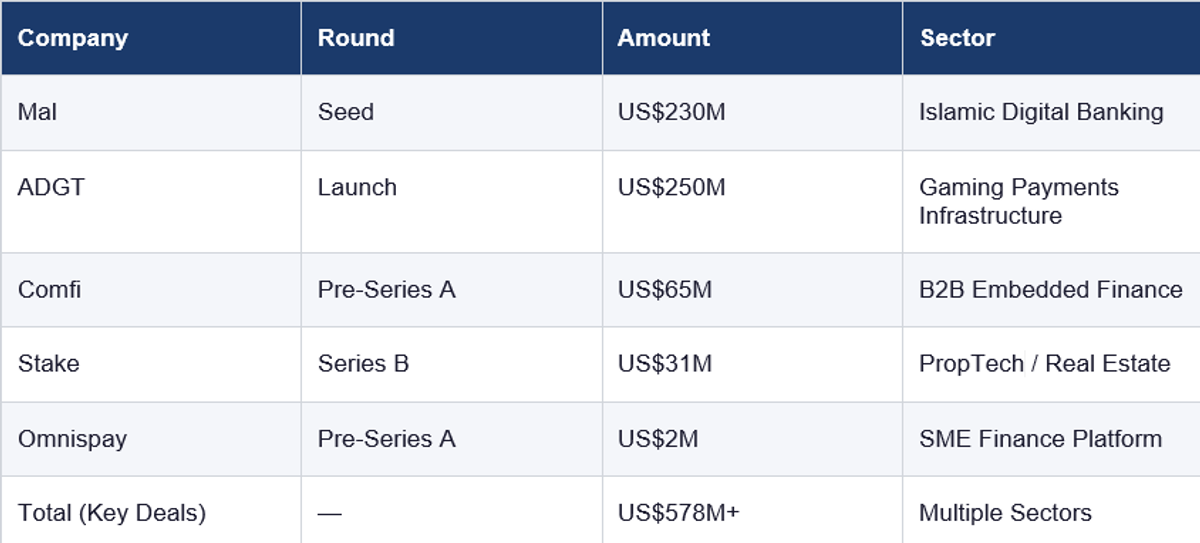
The standout deal of the quarter, and arguably one of the most significant seed rounds the Gulf has ever seen came from Mal, an Abu Dhabi-based Islamic digital bank that raised US$230 million in January.
Mal is built around a straightforward but ambitious premise: use AI to deliver mobile-first, Shariah-compliant financial products at a cost that traditional Islamic banks simply cannot match. The target market is the 1.8 billion-strong global Muslim population that remains significantly underserved by modern digital banking.
The regulatory groundwork is already in motion. Mal is in active discussions across the UAE, Bangladesh, Indonesia, and Pakistan, a geographic cluster that collectively represents hundreds of millions of potential customers with smartphones but limited access to formal, compliant banking.
For B2B readers: Mal's infrastructure ambitions extend beyond consumer accounts. Shariah-compliant embedded finance, payroll solutions, SME credit, supply chain financing is very much part of the longer-term product roadmap.
Comfi, Embedded B2B FinanceUS$65 Million Pre-Series A
Dubai-based Comfi raised US$65 million in a combined equity and debt round, and it is worth understanding exactly what they do, because it solves a problem most B2B operators recognise immediately.
Comfi provides Buy Now Pay Later for businesses, not consumers. Specifically, it offers BNPL and invoice discounting to SMEs in sectors like healthcare and automotive, where long payment cycles create chronic cash flow pressure. The platform already serves over 1,000 SMEs, which is a meaningful commercial footprint for a pre-Series A company.
The embedded finance model matters here. Comfi does not want to be an app businesses log into separately. It wants to be the financing layer sitting invisibly inside the procurement and payments tools that SMEs already use. That is the direction the entire sector is moving, and the funding suggests investors agree.
Omnispay, SME Finance PlatformUS$2 Million Pre-Series A
Smaller in size but notable for its strategic direction, Omnispay raised US$2 million to complete its transition from a payment settlement provider into a full-stack Shariah-compliant SME finance platform.
The core product is built around three integrated workflows: collect, pay, and borrow. For a business owner managing payments from clients, obligations to suppliers, and a need for short-term working capital, that three-in-one structure removes a lot of operational friction. The Shariah-compliant positioning also opens doors into a segment of the UAE market that existing non-compliant platforms cannot easily serve.
ADGT, Gaming Payments InfrastructureUS$250 Million Launch
Advanced Digital Gaming Technology (ADGT) was the quarter's other nine-figure story, raising US$250 million at launch in March through a strategic partnership between Blackstone, Raya Holding, NRT Technology, and Sightline Payments.
ADGT is building payments and compliance infrastructure specifically for the commercial gaming sector digital wallets, real-time payout rails, and regulatory compliance tooling. It is a specialist play in a sector that handles enormous transaction volumes but has historically been served by fragmented, legacy payment systems.
For B2B readers outside the gaming sector, ADGT's model is worth watching because the architecture it is building high-frequency transaction processing with real-time compliance verification has applications well beyond gaming. Logistics, insurance, and financial services all face versions of the same infrastructure challenge.
Stake, Digital Real Estate InvestmentUS$31 Million Series B
Stake, the digital real estate investment platform, closed an oversubscribed US$31 million Series B, the word 'oversubscribed' doing real work here, signalling that demand from investors exceeded what the company was seeking.
The numbers that attracted that demand are straightforward: 130% compound annual growth rate in gross merchandise volume. Stake allows retail and institutional investors to buy fractional ownership in income-generating real estate assets, and it has built that model into something investors clearly believe has room to scale significantly further.
The new capital is earmarked for two fronts: deepening its Saudi Arabia operations and entering the US industrial real estate market. The company is also progressing regulated tokenization efforts in partnership with Property Finder, which, if successful, would put Stake at the intersection of real estate investment and blockchain-based asset ownership, a space attracting serious institutional attention globally.
Q1 2026 UAE Fintech Funding at a Glance
What This Quarter Is Actually Telling Us
The pattern across these deals is consistent: investors are not chasing novelty. They are backing companies that solve infrastructure problems, the unglamorous, essential plumbing of financial services that determines whether businesses can actually move money, access credit, and stay compliant in multiple markets simultaneously.
That is a healthy sign for the ecosystem. It suggests UAE fintech is moving past the early hype cycle into something more durable. Companies that can demonstrate cross-border scalability, regulatory compliance, and genuine B2B utility are the ones attracting capital, and the ones most likely to still be operating at scale in five years.
For businesses operating in the UAE and across the broader MENA region, the practical implication is straightforward: the digital financial infrastructure available to you is improving faster than it ever has. Better payment rails, cheaper credit access, and more compliant digital tools are coming, and Q1 2026 is part of what is funding their arrival.