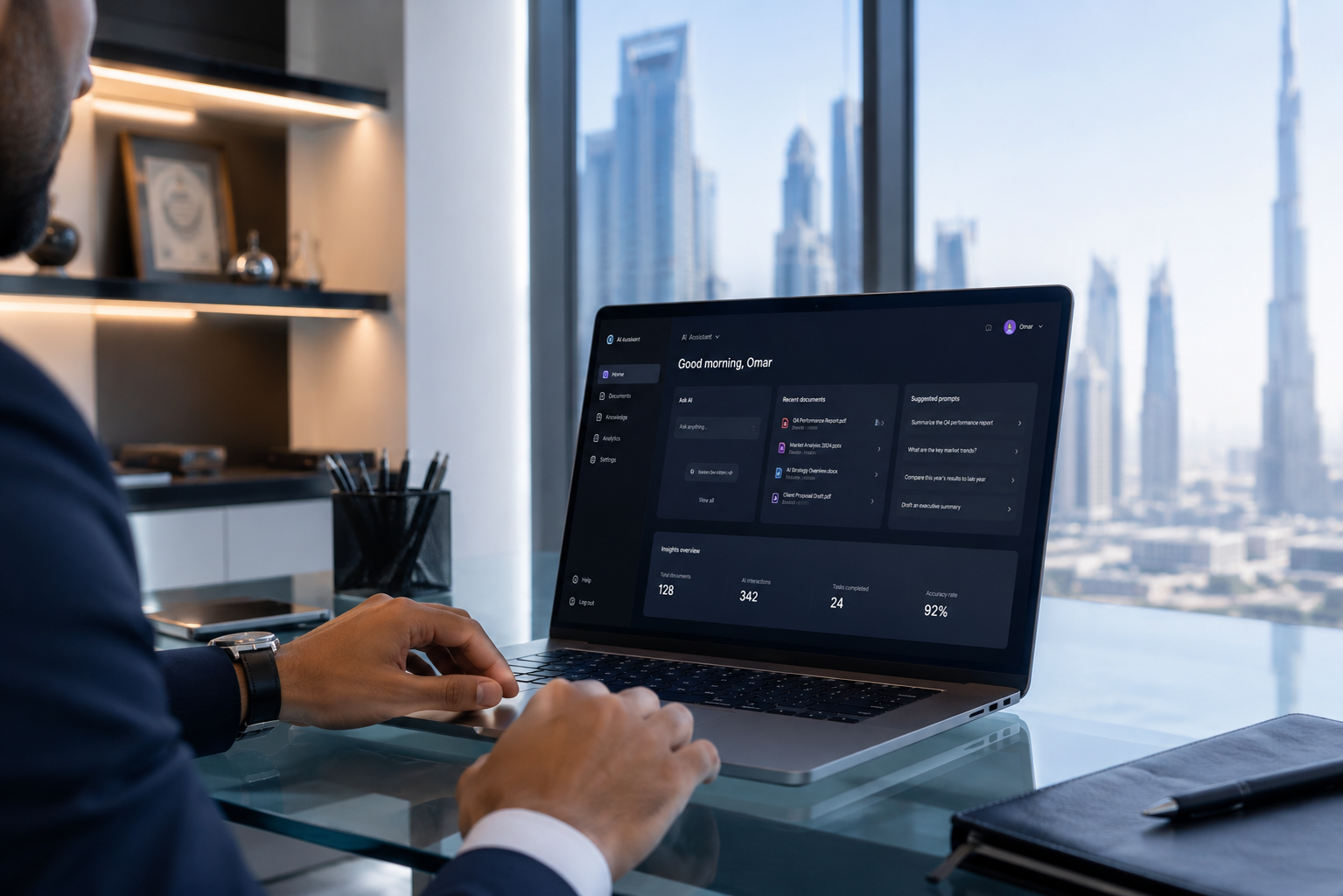
The personal computer has gone through several defining moments. The move from desktops to laptops. The shift to touchscreens. The arrival of cloud connectivity. Now a new category is being built: the AI PC, a machine designed from the ground up to run artificial intelligence workloads on the device itself, without routing every task through a remote data centre.
For B2B technology decision-makers across the Gulf, this is a shift worth taking seriously now. The hardware is here, the software is catching up, and the biggest names in the industry are committing serious investment.
What Exactly Is an AI PC?
An AI PC is a computer with specialised hardware that lets it process AI tasks locally, directly on the device. This means it can run applications like AI assistants, content generation tools, automated workflows, and productivity software without a constant internet connection or heavy reliance on cloud infrastructure.
The defining component is the Neural Processing Unit, or NPU. Think of it as a third processor inside the machine, sitting alongside the traditional CPU and GPU. While the CPU handles general computing and the GPU handles graphics and parallel tasks, the NPU is purpose-built for AI. It processes machine learning workloads faster, more efficiently, and with lower power consumption than general-purpose chips.
Some advanced AI PCs can even run local AI model training, a capability that was, until recently, reserved for server rooms and data centres.
NVIDIA Sets the Agenda at Computex 2026
The announcement that pulled this category firmly into the spotlight came from Nvidia CEO Jensen Huang at Computex, the flagship technology conference held annually in Taiwan. Huang unveiled the RTX Spark chip, developed in collaboration with MediaTek, designed specifically to power AI agents that can perform tasks independently on a user's computer, with no cloud dependency required.
NVIDIA is framing this as a collaboration with Microsoft to fundamentally reinvent the personal computer for the AI era. The ambition is clear: make every PC a capable AI machine, not just a terminal that connects to AI elsewhere.
The Manufacturers Are Already Moving
This is not a concept stage conversation. Production is underway. Laptops and compact desktops powered by the RTX Spark chip are expected to launch later in 2026. Meanwhile, a growing number of devices already carry Microsoft's Copilot+ PC designation, the first official hardware standard built around advanced AI features.
The companies building these machines include ASUS, Dell, HP, Lenovo, Microsoft, MSI, Acer, and Gigabyte. Every major manufacturer is in the race.
HP reported that AI-optimised computers made up 44% of its PC shipments in the second quarter of 2026, an indication of how quickly the category is becoming mainstream at the enterprise level. Dell has taken a more measured tone, noting that AI-driven demand has not yet reached the levels initially anticipated, suggesting adoption is strong but building in stages rather than arriving all at once.
The Business Case: Why This Matters Beyond the Specs
For enterprise buyers, three practical considerations make AI PCs relevant right now.
The first is speed. Local processing eliminates the round-trip latency of cloud AI calls. For workflows involving real-time analysis, document processing, or AI-assisted communication, that speed difference compounds over a working day.
The second is privacy. When sensitive business data, client records, or internal communications are processed locally rather than sent to external servers, the risk surface is fundamentally different. This is particularly relevant for businesses operating under data residency requirements or handling regulated information.
The third is cost. Cloud AI usage is metered. As teams rely more heavily on AI tools throughout the working day, cloud computing costs accumulate. An AI PC shifts a portion of that compute burden to a one-time hardware investment.
Privacy Concerns: The Microsoft Recall Lesson
Not every development in this space has landed cleanly. Microsoft's Recall feature, first announced in 2024, drew significant public criticism. The feature was designed to record user activity, including browsing history and voice interactions, to enable AI-powered search across a user's own digital history.
Following those concerns, Microsoft delayed the rollout, strengthened security protections, and eventually released Recall as an opt-in preview feature for a limited group of users. The episode was a useful reminder that local processing capability is a privacy benefit only when it is implemented with clear user control and strong data governance.
What Could Slow This Down?
The enthusiasm is real, but so are the headwinds. Memory chip shortages, rising component costs, and supply chain pressures are all factors that analysts believe will constrain adoption through 2026. Market research firm IDC expects global PC shipments to decline overall this year, even as higher average selling prices lift the total value of the market.
That means the growth of AI PCs is happening against a backdrop of a tightening overall market, which reinforces the case for buying strategically rather than broadly.
Where This Is Headed
The direction of travel is clear. AI is moving from the cloud to the device. The companies that understand this early and align their hardware procurement strategies accordingly will be better positioned as AI becomes embedded in every layer of business operations.
For Gulf-based businesses evaluating their next hardware refresh cycle, AI PCs represent a category that deserves a serious look today, not next year.