The United Arab Emirates has done something no traditional economy managed to do quietly: it made itself the world's most attractive place to start and scale a business not once, but five years running.
That's not marketing language. The Global Entrepreneurship Monitor (GEM) Report ranked the UAE first globally for the fifth consecutive year, while the StartupBlink Global Startup Ecosystem Index placed the country first regionally and inside the global top five. For B2B founders, regional investors, and multinational expansion teams, those numbers are hard to ignore.
So what's actually behind this? Industry leaders and operators on the ground point to a combination of structural advantages that few nations have managed to replicate all at once.
Geography That Works Like a Business Tool
The UAE sits at the intersection of Europe, Asia, and Africa, and that's not just a talking point on a pitch deck. Diana Cichy, Founder and CEO of CICHE International Trade & Investment, puts it directly: billions of consumers live within a single-flight radius of Dubai International Airport. For any B2B business with cross-border ambitions, that physical reach is a genuine operating advantage.
But geography is only the start. The UAE has a layered business-friendly policy on top of it:
- 100% foreign ownership across most sectors, no local partner required
- Specialised free zones tailored for tech, finance, logistics, healthcare, and more
- Golden Residency Visas give investors and senior talent long-term stability
- AI-driven public services, with a government mandate to digitalise 50% of services using artificial intelligence
The Fintech Angle: Why Regulators Are Part of the Pitch
Willem van Wyk, Managing Director of HDI Global's Dubai office, highlights that the UAE has struck a balance most countries struggle with: it moves fast on innovation without loosening the security guardrails that institutional investors and enterprise clients demand.
That credibility comes from its financial regulatory architecture. The Central Bank of the UAE, the Dubai International Financial Centre (DIFC), and the Abu Dhabi Global Market (ADGM) form a regulatory trio that underpins the entire ecosystem.
What Founders Say About Choosing Dubai Over San Francisco
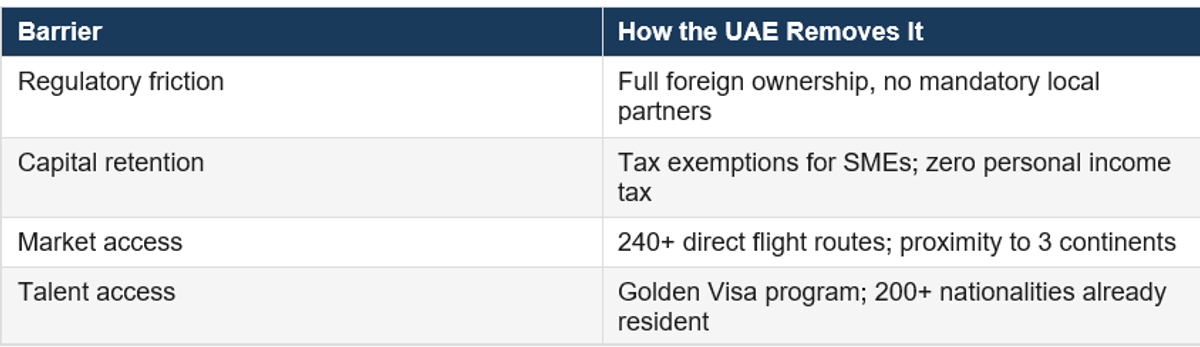
For technology founders making the decision today, the UAE's case is increasingly practical. Aaqib Gadit, Founding Partner at Disrupt.com, makes the point plainly: the UAE has systematically removed the four barriers that typically kill startups before they scale infrastructure gaps, policy friction, access to capital, and limited market reach.
Government Funds That Actually Move the Needle
What separates the UAE's ecosystem from others that talk a good game is the depth of institutional backing. Several government-anchored programmes are specifically designed to take companies from the early stage to international:
- Emirates Growth Fund: Targets Emirati companies scaling internationally in manufacturing, healthcare, food & agriculture, and advanced technology.
- Khalifa Fund & MBRIF: Provide SMEs with targeted capacity-building, financial support, and sector-specific guidance.
- Hub71: Abu Dhabi's flagship tech ecosystem connecting startups with investors and corporate deal flow.
- Dubai Entrepreneurs Campus: A joint initiative by Dubai DET and Dubai Chamber of Digital Economy its first accelerator cohort recently completed with demonstrable results.
Dominating the Global Leaderboards
The UAE is one of only four countries worldwide that meet or exceed every benchmark on the global entrepreneurship ecosystem index. It ranks inside the top five globally for international market accessibility. By hosting over 200 nationalities within a single, multicultural jurisdiction, the UAE has moved beyond being simply a good place to register a company; it has become the operational headquarters of choice for founders who want to build globally.