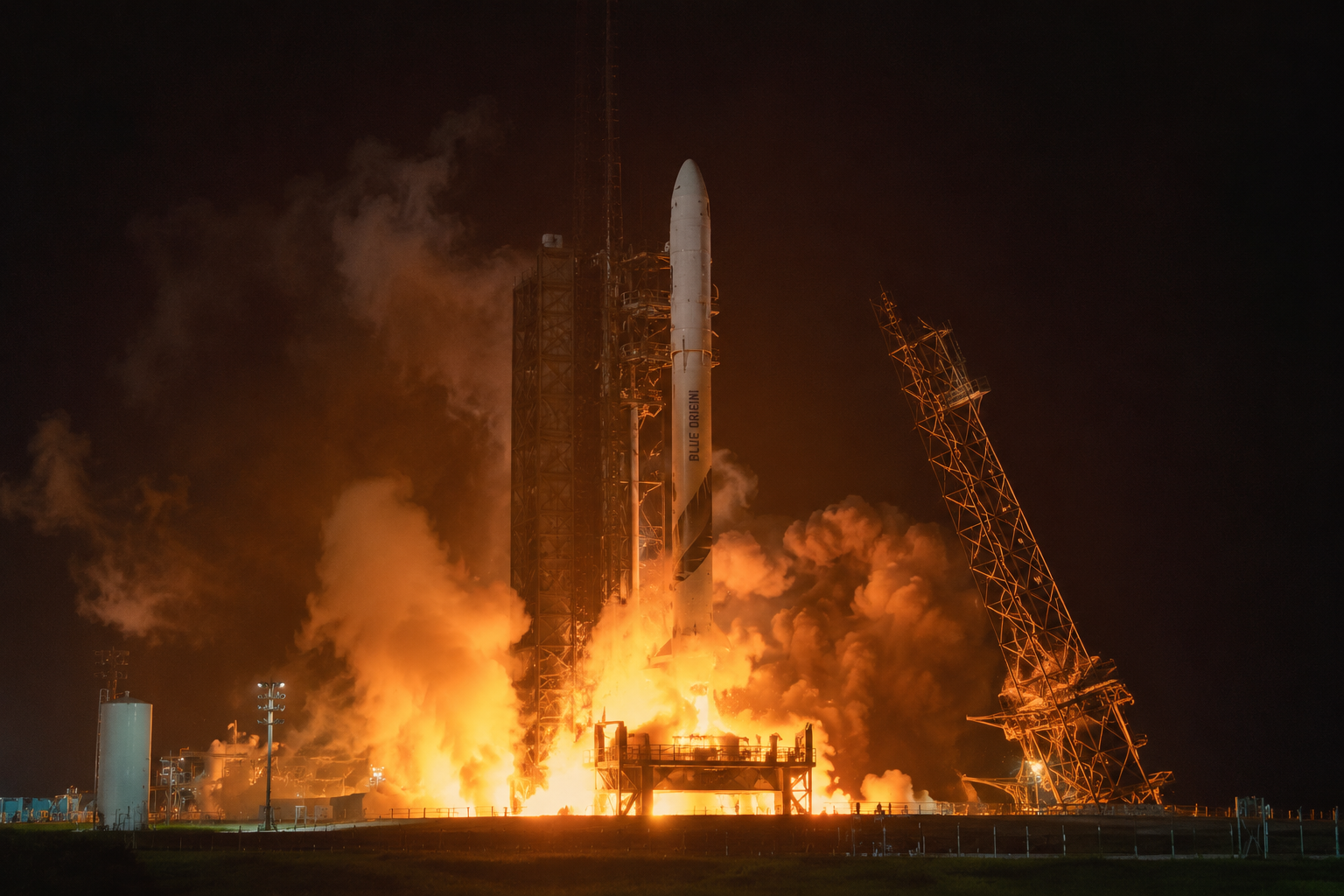
It was supposed to be a routine engine test. Instead, Blue Origin's New Glenn heavy-lift rocket was destroyed Thursday night in a catastrophic explosion at Launch Complex 36 (LC-36) at Cape Canaveral Space Force Station in Florida, and the fallout is far bigger than one lost rocket.
The blast occurred at approximately 9:00 PM local time. The vehicle, an uncrewed booster named 'No, It's Necessary,' was conducting a static fire test of its seven BE-4 first-stage engines when something went critically wrong, triggering a massive fireball. The pressure wave from the explosion was strong enough to rattle windows in nearby Cocoa Beach and Cape Canaveral, with residents reporting feeling physical tremors. Blue Origin confirmed all personnel had been safely evacuated before the test; there were no injuries or fatalities.
The Damage Goes Beyond the Rocket
The explosion did not just destroy the vehicle. It severely damaged LC-36, which is Blue Origin's only operational orbital launch facility. Video and tracking footage confirmed that the force of the blast toppled one of the pad's large lightning protection towers, a visible sign of just how intense the event was.
The destroyed booster had been in active preparation for the NG-4 mission, which was scheduled to carry 48 Amazon Project Kuiper broadband internet satellites into orbit. Amazon confirmed the satellite payload had not yet been integrated onto the upper stage during the test, meaning the Kuiper hardware itself was not damaged. However, the loss of the launch vehicle and the damage to the pad mean New Glenn operations will be grounded for months while the Federal Aviation Administration (FAA) investigates the accident and engineers carry out extensive reconstruction of the launch facility.
This Is Not Blue Origin's First Bad Week
Context matters here. This explosion follows an already-difficult stretch for the New Glenn program. Just weeks earlier, on April 19, the NG-3 mission suffered an upper-stage malfunction that left its satellite payload stranded in an incorrect orbit, a mission failure that had already raised questions about the vehicle's reliability.
The consecutive setbacks are significant because New Glenn is not just a commercial launch vehicle. It carries major government contract obligations. The NASA Artemis Program has selected New Glenn as the designated launch vehicle for the Blue Origin Mark 1 and Mark 2 lunar landers. These landers are core to NASA's plans for returning humans and robotic systems to the lunar surface. A months-long grounding of New Glenn directly impacts the timeline of one of the most ambitious space programs currently active.
Blue Origin also holds a $20 billion NASA contract to lead the first uncrewed lunar missions, which are intended to lay the groundwork for a future permanent Moon base. Every month of delay chips away at that timeline.
Bezos Responds; Musk Comments
Jeff Bezos responded publicly on social media following the incident, saying: "Too early to know the root cause, but we're already working to find it. Very rough day, but we'll rebuild whatever needs rebuilding and get back to flying."
SpaceX CEO Elon Musk, whose Falcon 9 and Starship programs are New Glenn's primary commercial rivals, offered a brief acknowledgement: "Most unfortunate. Rockets are hard."
For business stakeholders in the Gulf region watching the commercial launch market, this incident is a reminder that the competitive space launch sector, where both Amazon and SpaceX are racing to deploy global broadband satellite networks, remains technically unforgiving. The disruption to Project Kuiper's launch schedule may have downstream implications for the timeline of satellite internet availability in parts of the Middle East and Asia.