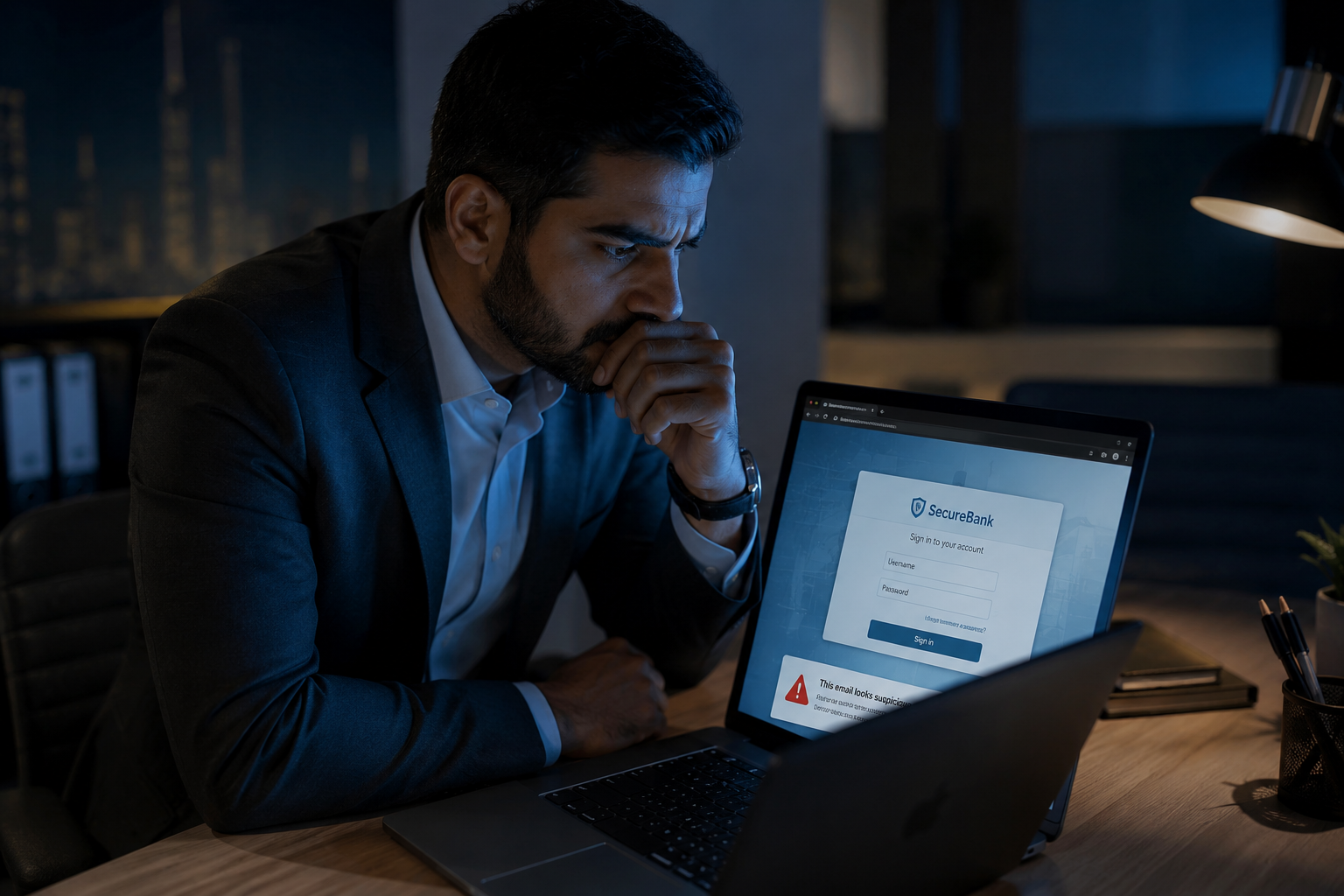
The Threat That Is Hard to See Coming
If you work in a UAE business today, you are almost certainly being targeted by credential phishing. The question is whether you know what it looks like in its current form, because today's attacks look nothing like the obviously fake emails of five years ago.
Credential phishing is a cyberattack technique designed to steal usernames, passwords, and login details. It does this by convincing people they are interacting with something legitimate: a bank, a government portal, a cloud service provider, or even a colleague. Once attackers have those credentials, they have the keys to accounts, financial systems, and corporate infrastructure.
What makes the current wave of attacks different is artificial intelligence. AI is allowing cybercriminals to craft messages, clone websites, and even replicate voices and video at a level of detail that is genuinely difficult to distinguish from the real thing.
The Data Behind the Threat
The UAE Cybersecurity Council has released figures that put the scale of the problem in stark perspective:
- More than 75% of cyber breaches in the UAE begin with a phishing email or fraudulent message
- AI-powered phishing campaigns now account for a significant share of digital security incidents in the region
- The UAE's rapid push into digital government services, smart banking, and connected healthcare has expanded the attack surface considerably
This connects directly to a broader pattern. The Middle East is leading the world in AI governance at the board level, but that organizational awareness has not yet fully trickled down to individual employee behavior and daily security habits.
How These Attacks Actually Work
Modern credential phishing attacks are not random spam blasts. They are targeted, personalized, and increasingly automated. Here is the typical playbook:
- A target receives an email, SMS, or WhatsApp message that appears to come from their bank, employer, or a government service
- The message creates urgency, perhaps warning of suspicious activity on an account or requesting immediate verification
- The link directs to a cloned website, sometimes pixel-perfect, asking for login credentials
- In more sophisticated attacks, AI generates voice messages or video calls impersonating known contacts to increase credibility
- Once credentials are entered, attackers gain immediate access and can move funds, exfiltrate data, or escalate access within corporate networks
The UAE's digital transformation ambitions, detailed in initiatives like the new Federal Authority for AI and Data, are creating extraordinary opportunities. They also create new vulnerabilities that phishing campaigns are actively exploiting.
Why Even Professionals Are Getting Caught Out
The old advice about phishing was simple: look for bad spelling, suspicious sender addresses, and obvious visual flaws. That advice is becoming dangerously outdated.
AI tools can now generate grammatically perfect emails that match the writing style of known contacts. Websites can be cloned within hours. Voice synthesis technology can replicate a senior executive's speech pattern convincingly enough to fool colleagues on a phone call. These are not theoretical capabilities. They are being actively used in campaigns targeting UAE businesses.
Cybersecurity companies active in the UAE, including those showcased at the UAE Government Cybersecurity Summit, are developing AI-powered detection systems to counter these threats. But the technology race between attackers and defenders is genuinely close.
What Organizations and Individuals Can Do Right Now
Cybersecurity authorities in the UAE recommend the following practical steps:
- Enable multi-factor authentication (MFA) on every account that supports it. This is the single most effective individual defense
- Verify the authenticity of any message requesting login details by contacting the organization directly through a known, trusted channel. Not the contact details in the suspicious message
- Avoid clicking QR codes in unexpected emails or physical locations, as these are an increasingly common phishing vector
- Never share passwords or one-time codes through any communication channel, regardless of how legitimate the request appears
- Organizations should invest in phishing simulation training that uses current AI-generated examples, not outdated templates
- IT teams should implement email authentication protocols such as DMARC, DKIM, and SPF to reduce spoofed sender addresses
For businesses building their cybersecurity posture in the UAE, it is worth noting that the UAE fintech regulatory environment increasingly requires demonstrable cybersecurity compliance as part of licensing and operational standards.