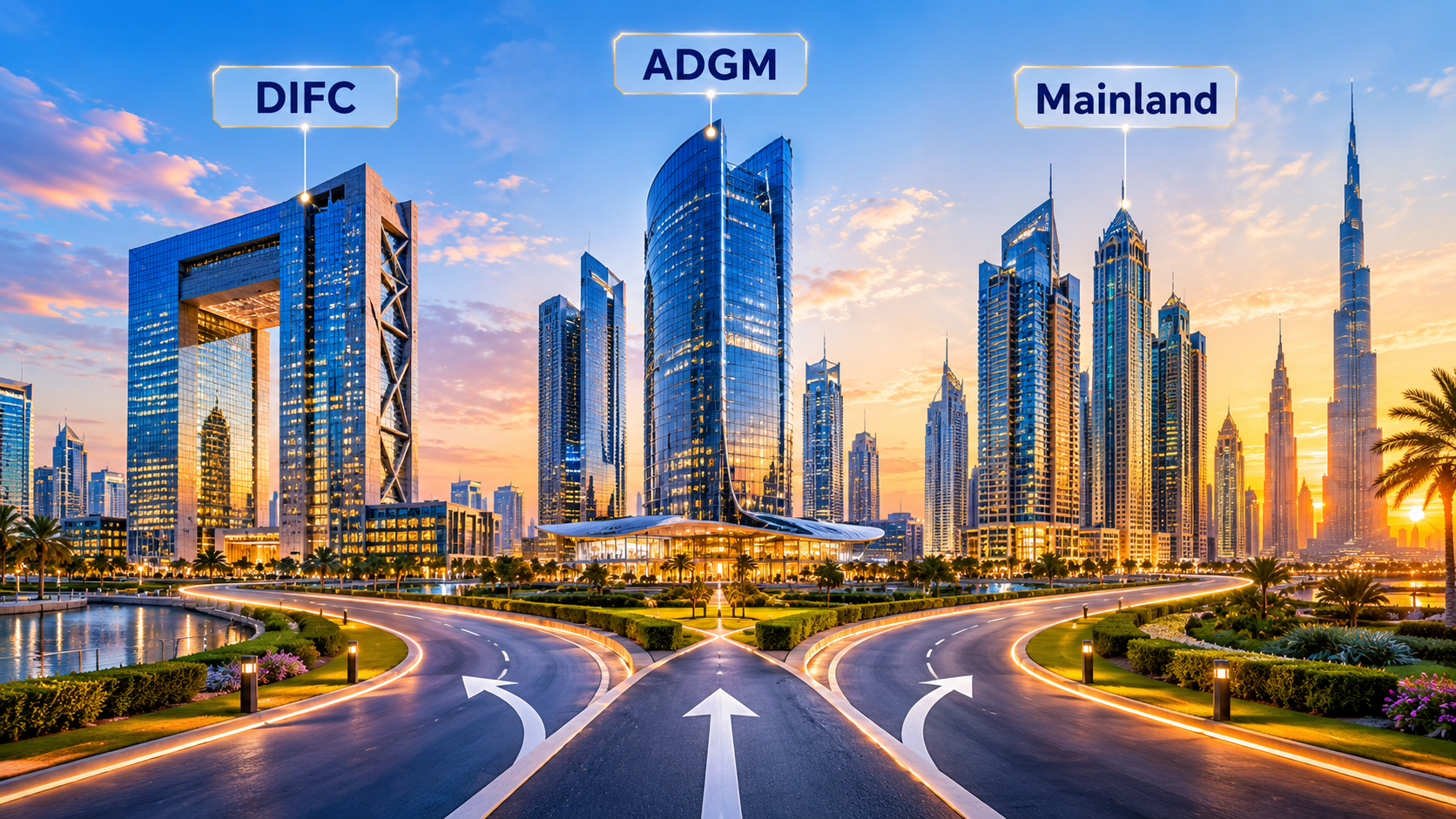
If you are setting up a business in the UAE this year, one question will come up faster than almost anything else: should you go with the Dubai International Financial Centre (DIFC), the Abu Dhabi Global Market (ADGM), or the Dubai Mainland? All three are legitimate, respected options. But they are built for different types of founders, and choosing the wrong one can slow you down, cost you money, or leave you structurally misaligned with your own growth plans.
This guide cuts through the marketing language and gives you a real-world comparison of each structure, including what they cost, who they are actually suited for, and how the decision plays out as your startup scales.
For a broader context on the ecosystem you will be entering, the GCC Venture Capital Report June 2026 is worth reading before you commit to any structure.
Why the Structure Decision Matters More Than People Realise
Most founders treat business structure as an admin task. They pick whatever their business setup agent recommends, pay the fees, and move on. That is a mistake.
Your legal structure determines where you can operate, who you can hire, how your contracts are governed, which investors will look at you seriously, and how much tax you will pay once the UAE corporate tax regime fully beds in. Getting this right from day one is one of the highest-leverage decisions you will make in the early life of your company.
The good news is that 2026 is an excellent year to be making this decision. All three jurisdictions have updated their frameworks, reduced friction in their onboarding processes, and become considerably more founder-friendly than they were even three years ago. The question is not which is best in general. It is which is best for your specific situation.
If you are just starting to explore how business registration works in Dubai, the How to Register a Company in Dubai Free Zones 2026: The Complete Step-by-Step Guide is a practical companion to this article.
DIFC: The Gold Standard for Fintech, Finance, and Professional Services
The Dubai International Financial Centre is a financial free zone established under its own legal framework, separate from both Dubai law and UAE federal law. It follows a Common Law system based on English law, administered by the DIFC Courts. For many international founders, that alone is the deciding factor.
What DIFC is designed for
DIFC is purpose-built for financial services, fintech, asset management, legal and consulting firms, family offices, and companies that need international-grade regulatory credibility. If you are raising capital from global institutional investors, signing complex multi-jurisdiction contracts, or building a regulated financial product, DIFC gives you a framework that those counterparties already trust.
What it costs
DIFC is the most expensive of the three options. Expect setup costs starting around AED 30,000 to AED 50,000, with annual fees that can reach AED 20,000 or more, depending on your license category and office requirements. Physical office space within DIFC is premium-priced, though the zone does offer flexi-desk and co-working options through DIFC Fintech Hive and related facilities.
Key advantages
- The Common Law legal system is trusted by global investors and counterparties
- Access to the DIFC Courts, one of the most respected commercial court systems in the region
- Strong regulatory framework through the Dubai Financial Services Authority (DFSA)
- Direct access to a cluster of financial institutions, funds, and professional services firms
- 100% foreign ownership with zero restrictions on capital repatriation
Watch points
- High setup and operating costs relative to mainland or standard free zones
- Activity restrictions: DIFC licenses are not suited for retail, manufacturing, or most B2C consumer businesses
- Operating outside DIFC requires additional licenses or a mainland entity
ADGM: Abu Dhabi's Answer to DIFC and a Serious Competitor
The Abu Dhabi Global Market was established in 2015 and has grown rapidly into a credible alternative to DIFC, particularly for founders who want a Common Law jurisdiction outside of Dubai or who are strategically positioning their business closer to Abu Dhabi's sovereign wealth and government infrastructure.
What ADGM is designed for
ADGM caters to financial services, technology companies, startups, and professional services. Its Regulatory Laboratory (RegLab) is one of the region's most respected fintech sandbox programmes, making it particularly attractive for early-stage companies building regulated financial products who want structured support rather than a full licence upfront.
ADGM has also developed a strong reputation in the digital assets space. If your startup operates in crypto, blockchain infrastructure, or tokenised finance, ADGM's framework for virtual asset activities is one of the most mature in the Gulf.
What it costs
ADGM is broadly comparable to DIFC in terms of cost for regulated activities, though it has made targeted efforts to attract startups with more accessible entry points through its Emerging Business Licence, which starts at lower fee levels for early-stage companies with revenue below a defined threshold.
Key advantages
- Common Law jurisdiction with its own independent courts
- Strong framework for digital assets and fintech innovation
- RegLab sandbox for regulated product development without a full licence requirement
- Abu Dhabi location provides strategic access to ADNOC, Mubadala, and ADQ ecosystems
- Emerging Business Licence offers a lower-cost entry for qualifying startups
Watch points
- Located in Abu Dhabi, which adds friction if your team and clients are predominantly Dubai-based
- Smaller ecosystem density compared to DIFC in pure headcount terms
- Still building name recognition among some international investor categories compared to DIFC's established brand
Dubai Mainland: The Most Flexible Option for Market Access
A Dubai Mainland company is licensed through the Department of Economic Development (DED) and gives you the broadest commercial freedom of the three options. You can trade directly with the local UAE market, open branches anywhere in the country, bid for government contracts, and operate without geographic restriction.
What the mainland is designed for
Mainland licensing suits companies that need physical retail presence, want to serve UAE consumers directly without a local distributor, are building B2B relationships with UAE government entities, or operate in sectors not permitted in free zones, such as certain construction, healthcare delivery, or retail activities.
It is also the natural structure for companies that want to operate across the UAE without restriction, rather than being notionally limited to a free zone's designated area. In practice, many free zone companies trade outside their zone through workarounds, but the mainland gives you clean, unrestricted access from day one.
Ownership structures in 2026
This is where the mainland has changed significantly. Since the 2021 reforms to the UAE Commercial Companies Law, the majority of business activities on the mainland now permit 100% foreign ownership without a local sponsor. The requirement for an Emirati partner or local service agent has been removed for most commercial sectors. There are still some reserved activities where Emirati ownership requirements apply, but for most tech, services, and B2B businesses, this is no longer a barrier.
What it costs
Mainland setup costs vary widely depending on activity, office space, and the number of visas. A basic DED licence for a services company can start around AED 10,000 to AED 20,000, though office lease requirements add to the total. The mainland does not allow virtual offices in the same way some free zones do, so factor in a minimum lease cost.
Key advantages
- Unrestricted ability to trade directly with the UAE market and government entities
- No geographic restriction on where you operate within the UAE
- 100% foreign ownership is now available for most commercial activities
- A broad activity list covering sectors unavailable in free zones
- Strong banking relationships, as major UAE banks tend to prefer mainland entities
Watch points
- Governed by UAE Civil Law rather than Common Law, which can be a concern for international investors
- Physical office requirements add to running costs
- Less suited to companies targeting international institutional capital who prefer Common Law jurisdictions
Side-by-Side Comparison
Here is how the three structures stack up on the key decision factors:
| Factor | DIFC | ADGM | Dubai Mainland |
|---|---|---|---|
| Legal System | Common Law (English) | Common Law (English) | UAE Civil Law |
| Foreign Ownership | 100% | 100% | 100% (most activities) |
| Setup Cost (est.) | AED 30,000 to 50,000+ | AED 15,000 to 40,000+ | AED 10,000 to 25,000+ |
| UAE Market Access | Limited (finance focus) | Limited (finance/tech focus) | Unrestricted |
| Government Contracts | Restricted | Restricted | Yes |
| Best For | Fintech, finance, PE/VC | Fintech, digital assets, startups | Consumer, retail, B2B, SaaS |
| Investor Credibility | Very High (institutional) | High and growing | Moderate to High |
| Corporate Tax | 0% (within zone) | 0% (within zone) | 9% on profits above AED 375K |
| Dispute Resolution | DIFC Courts | ADGM Courts | UAE Courts |
| Regulatory Body | DFSA | FSRA | DED / Sector regulators |
Corporate Tax: What You Need to Know in 2026
The UAE's 9% corporate tax, introduced in 2023, applies to businesses earning over AED 375,000 in annual profit. However, companies operating within DIFC and ADGM continue to benefit from a 0% corporate tax rate on qualifying income, as both are designated free zones that meet the conditions set by the Federal Tax Authority.
Dubai Mainland companies are subject to the 9% rate on taxable profits above the AED 375,000 threshold, though small businesses and qualifying free zone persons who conduct minimal mainland activity may still benefit from the 0% rate under specific conditions. This is an area where the rules require careful review with a qualified tax advisor, as the interaction between free zone status and mainland activity is nuanced.
For startups in the early stages with limited profit, the tax differential may be less decisive than other factors. But for companies anticipating rapid revenue growth, the jurisdictional tax treatment deserves serious modelling before you commit to a structure.
Which Structure Fits Which Startup Type
Choose DIFC if you are...
- Building a regulated financial product, investment platform, or fund management business
- Raising capital from global institutional investors who expect Common Law governance
- Running a law firm, professional services company, or family office targeting HNWI clients
- Prioritising access to DIFC's dense ecosystem of financial counterparties
Choose ADGM if you are...
- Building a fintech or digital assets company and want a RegLab sandbox pathway
- Strategically targeting Abu Dhabi's sovereign wealth and government ecosystem
- An early-stage startup that qualifies for ADGM's Emerging Business Licence pricing
- Looking for a Common Law jurisdiction with strong virtual assets regulation
Choose Dubai Mainland if you are...
- Building a consumer product, SaaS platform, or B2B services company targeting UAE clients directly
- Planning to tender for UAE government contracts at any point in your company's life
- Running a business in retail, F&B, healthcare, or another sector with physical UAE presence requirements
- Looking for maximum flexibility to operate across the UAE without geographic restriction
A Note on Dual Structures
Many growth-stage companies in the UAE operate a dual structure: a DIFC or ADGM holding company paired with a Dubai Mainland operating entity. This approach gives you the investor-friendly legal wrapper of a Common Law jurisdiction at the top of your corporate structure, while retaining the full commercial flexibility of a mainland operating licence on the ground.
The trade-off is cost and administrative complexity. Running two entities means two sets of compliance requirements, two annual fee structures, and more involved accounting. For early-stage startups watching cash flow carefully, this may not be the right approach initially. But as you scale toward a Series A or plan for international expansion, it is worth knowing the option exists.
This is also the structure that tends to appeal most to international founders who are not yet UAE residents and want to keep their personal liability and tax exposure clearly separated from their operating entity.
What Investors Actually Look For
If you are planning to raise venture capital, the structure of your company will come up in due diligence. Here is an honest summary of how each option is typically perceived:
DIFC is the most internationally recognised. A DIFC-incorporated company signals credibility to institutional investors, global law firms, and sophisticated family offices. If you are raising from a London, Singapore, or New York fund, they have almost certainly encountered DIFC entities before.
ADGM is growing in credibility and is particularly well-regarded by investors focused on the Abu Dhabi ecosystem, digital assets, and regulated fintech. It is not yet at DIFC's level of global name recognition but is moving in that direction quickly, supported by the Abu Dhabi government's sustained investment in the zone.
Dubai Mainland is perfectly fundable, and many of the UAE's fastest-growing companies are mainland entities. Regional VCs, angel networks, and family offices are very comfortable with DED-licensed businesses. The main consideration is that some international institutional investors may request a restructure into a Common Law holding company as a condition of their term sheet.
For more on where the regional capital is flowing right now, the UAE Startups Funding Roundup June 2026 tracks the most recent deals and investor activity.
The UK-GCC Trade Agreement and What It Means for Your Structure Choice
The recently signed UK-GCC Free Trade Agreement is creating new commercial pathways between the Gulf and the UK. For British founders setting up in the UAE, or UAE-based startups targeting the UK market, this agreement adds another dimension to the structure conversation.
DIFC's Common Law, English law-based framework means that UK counterparties dealing with a DIFC entity are operating within a familiar contractual environment. That familiarity reduces friction in negotiations and can accelerate deal timelines when the commercial relationship involves significant UK exposure. As the UK-GCC FTA begins to generate real commercial activity over the next twelve to eighteen months, this is a meaningful advantage worth factoring in.
Practical Steps Before You Decide
Before committing to any structure, work through these questions honestly:
- What is your primary market? If you are selling to UAE consumers or government entities, mainland almost certainly makes more sense. If you are dealing with international financial counterparties, DIFC or ADGM will serve you better.
- What does your investor roadmap look like? If you expect to raise from global institutional VCs within the next two years, a Common Law jurisdiction reduces friction. If your near-term capital will come from regional angels or family offices, the mainland is entirely workable.
- What is your budget for setup and ongoing compliance? DIFC and ADGM cost more to establish and maintain. That cost is often worth it, but it needs to be in your plan.
- Do you need to operate physically across the UAE? If yes, the mainland gives you unrestricted access. Free zone companies can trade outside their zone, but the process involves navigating additional licensing requirements.
- Are you in a regulated activity? If you are building anything that touches financial services, payments, lending, or digital assets, the regulatory environment of DIFC or ADGM is likely the right choice, regardless of cost.
The Bottom Line
There is no universally correct answer to the DIFC vs ADGM vs Dubai Mainland question. Each structure exists because different types of businesses have different needs, and the UAE has been deliberate about building all three into world-class options.
For regulated financial services and companies raising international institutional capital, DIFC is the benchmark. For fintech innovation and digital assets with an Abu Dhabi angle, ADGM is increasingly hard to ignore. For startups building market-facing businesses in the UAE, the mainland's commercial freedom and lower cost of entry make it the practical default for most founders.
The best advice is to make this decision with proper legal and commercial guidance rather than defaulting to what your business setup agent recommends based on margin. The structure you choose today will shape your options for the next decade.