Executive Summary
Dubai's startup ecosystem has reached a pivotal inflexion point in 2026. What was once a promising frontier market has matured into one of the most competitive and internationally connected innovation hubs on the planet. The city now hosts over 3,800 active startups with a combined valuation exceeding $32 billion, ranking 48th globally according to StartupBlink's Global Startup Ecosystem Index 2026.
This report provides a structured, data-driven overview of where the market stands, which sectors are generating the most investor activity, who the key players are, and what the rest of 2026 looks like for founders, operators, and capital allocators with exposure to the UAE.
The UAE led all MENA markets in Q1 2026, raising $625.8 million across 46 startup deals. Fintech alone accounted for 46% of total investment, with proptech second at $228.6 million.
1. Market Size and Ecosystem Overview
Dubai's startup scene has grown at a compounding rate that few emerging ecosystems have matched. The numbers that matter most for investors and founders in 2026 are these: the ecosystem ranks 48th globally, grew 6.9% in the past year, and has recorded over 1,100 funding deals year to date, according to ecosystem data aggregators. At the broader UAE level, the total active startup count now exceeds 5,600 firms, with Dubai accounting for the overwhelming majority of capital concentration.
In 2025, MENA startups raised a record $7.5 billion in venture capital, with the UAE capturing approximately $2 billion across 218 deals, second only to Saudi Arabia's $5 billion. Within the UAE, Dubai-based companies attracted 93% of all tech funding in the first half of 2025, a 133% increase over the prior half-year period, according to Waveup analysis of regional deal flow data.
The city's three confirmed unicorns have collectively raised more than $5.05 billion, with standout names including XPANCEO (valued at $1.35 billion after its $250 million Series A in July 2025), Kitopi (cloud kitchens), and Tabby (BNPL fintech, valued at $3.3 billion). Dubai's stated goal through its D33 Economic Agenda is to reach 30 unicorns by 2033, supported by $27 billion in committed government innovation funding.
Free Zone Infrastructure: A Structural Advantage
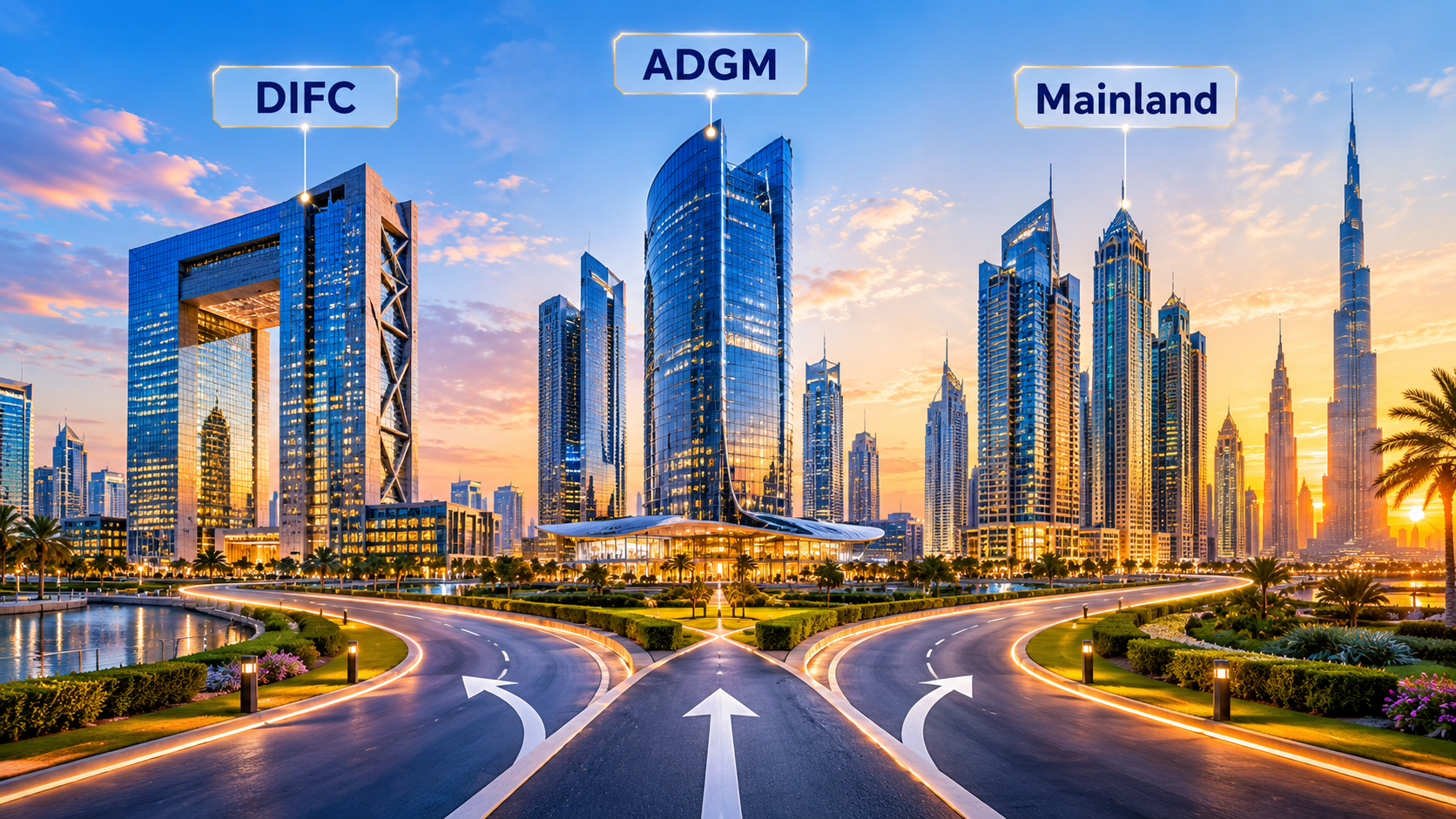
A significant part of Dubai's market appeal is structural rather than cyclical. The city's free zones, particularly the Dubai International Financial Centre (DIFC), Dubai Internet City (DIC), and Dubai Silicon Oasis (DSO), offer 100% foreign ownership, zero personal income tax, fast-track licensing, and subsidized workspace programs. Company registration that takes eight to sixteen weeks in many competing markets can be completed in approximately two weeks in Dubai's free zones, a material advantage for capital-efficient founders.
For founders considering where to base their operations, see our detailed guide: How to Register a Company in Dubai Free Zones 2026: The Complete Step-by-Step Guide.
2. Key Sectors: Where Capital Is Concentrating
Venture capital deployment in Dubai is not uniform across the economy. Three sectors, fintech, proptech, and artificial intelligence, account for the dominant share of both deal volume and deal size. Understanding this concentration is essential for anyone seeking to raise capital, partner with funded startups, or evaluate market opportunities.
| Sector | Q1 2026 / Recent Funding | Notable Players | Outlook |
|---|---|---|---|
| Fintech | 46% of Q1 2026 funding; $1.14B across MENA in 2025 | Tabby, Alaan, Flow48, Rain, Mal | Strong |
| Proptech | $228.6M in Q1 2026; $684M in Q3 2025 | Property Finder, Huspy, PRYPCO | Strong |
| AI / Deep Tech | AI investment tripled YoY in 2025; set to double in 2026 | XPANCEO, G42, CrayonLabs | Very Strong |
| E-Commerce | $265M across 14 deals in Q3 2025 | Kitopi, iMile, Eyewa | Stable |
| Logistics Tech | Fastest-scaling sector per Dubai Business Zone 2026 | Ninja, iMile | Growing |
| CleanTech | Driven by UAE Net Zero 2050 initiative | Multiple early-stage firms | Emerging |
| HealthTech | Growing post-pandemic infrastructure investment | Multiple pre-Series A firms | Emerging |
Fintech: The Anchor Sector
Fintech is and remains the dominant category for capital deployment in the UAE startup ecosystem. In Q1 2026, 25 fintech startups collectively raised the largest share of capital, accounting for 46% of total regional investment. In 2025, the sector attracted $1.14 billion across MENA, representing 26% of all VC deal volume. Dubai is where most of those deals are structured.
The standout names from recent cycles include Tabby (buy-now-pay-later, $3.3 billion valuation), Alaan (AI-powered spend management, $48 million Series A led by Peak XV Partners, formerly Sequoia Capital India), Flow48 (revenue-based financing, $69 million Series A), and Rain (crypto exchange, $58 million Series B in August 2025). The DIFC FinTech Hive accelerator continues to act as a structured pipeline for early-stage fintech founders seeking regulatory sandboxing and institutional introductions.
Proptech: Real Estate as a Technology Market
Dubai's real estate market, one of the most active in the world by transaction volume, has become a natural incubator for proptech innovation. In Q3 2025, proptech startups in the UAE raised $684 million, fueled largely by Property Finder's $525 million mega-round. In Q1 2026, proptech was the second-largest funded sector at $228.6 million.
The opportunity extends beyond brokerage and listings. PRYPCO, which has facilitated over $2.73 billion in mortgages, is now tokenizing real property title deeds in a formal partnership with the Dubai Land Department, the first such arrangement globally. Huspy, which operates across the UAE and Spain, received backing from General Catalyst in a pre-Series A round that marked the firm's first PropTech investment in the Middle East.
Artificial Intelligence: The Growth Frontier
AI represents the most significant emerging investment theme in Dubai's startup ecosystem for 2026. MAGNiTT data shows that AI investments across MENA tripled year-on-year in 2025 in terms of capital deployed, and the firm's 2026 outlook projects that figure to double again. Dubai's D33 agenda specifically prioritizes AI companies as future unicorn candidates, and the Dubai Economic Development Corporation has noted that AI firms represent an outsized proportion of startups being onboarded to new government-sponsored matchmaking programs.
Notable AI-native companies active in or based in the UAE include XPANCEO (smart contact lenses and wearable computing), CrayonLabs (AI product studio, founded within Dubai), and the broader G42 ecosystem anchored in Abu Dhabi but deeply integrated into Dubai's commercial infrastructure. The UAE as a whole has attracted 60% of the region's late-stage AI funding, according to industry body data from Q1 2026.
For a deeper analysis of the region's AI investment picture, see: The UAE Is Building One of the World's Most Ambitious AI Economies. Here Is What That Means for Business.
3. Key Players: Investors, Accelerators, and Anchor Startups
The Dubai ecosystem is supported by a combination of homegrown venture capital, regional sovereign funds, international participation, and government-backed accelerators. Understanding who is writing checks and at what stage is critical for founders approaching the market for the first time.
| Firm | Type | Focus |
|---|---|---|
| Wamda Capital | VC | Early to growth stage, MENA-wide |
| Shorooq Partners | VC | Seed to Series B, fintech and tech-enabled |
| BECO Capital | VC | Early stage, consumer and enterprise tech |
| Global Ventures | VC | Series A/B, cross-border tech |
| VentureSouq | VC | Seed and Series A, MENA and South Asia |
| Mubadala Investment Co. | Sovereign/LP | Late-stage, AI, infrastructure, global |
| DIFC FinTech Hive | Accelerator | Fintech, insurtech, regtech |
| Dubai Future Accelerators | Gov. Program | GovTech, smart city, AI pilots |
| In5 | Accelerator | Early stage tech, media, design, science |
Beyond these formal institutions, a growing angel layer has emerged through networks such as Dubai Angels and Womena, which focus on early-stage checks. International investors, including Wellington Management, Atomico, and Lightspeed Venture Partners, have participated in late-stage UAE rounds in 2025, signalling that Dubai has moved from a regional story to a globally investable market in select sectors.
Anchor Startups Shaping the Ecosystem
A small number of high-growth companies are reshaping the perception of what is buildable from Dubai. These are the companies that attract follow-on investor interest, create employment pipelines, and demonstrate that exits are achievable.
- Tabby: The region's dominant buy-now-pay-later platform at a $3.3 billion valuation, backed by Wellington Management and Sequoia Capital India, among others.
- Property Finder: The MENA real estate marketplace that raised approximately $525 million in 2025 and serves as the highest-profile proptech exit candidate in the region.
- XPANCEO: A deep tech unicorn developing smart contact lenses, headquartered in Dubai, that reached a $1.35 billion valuation following its July 2025 Series A.
- Kitopi: A cloud kitchen infrastructure platform valued at $1.6 billion with operations across the UAE, Saudi Arabia, Kuwait, and Bahrain.
- Alaan: An AI-powered corporate spend management platform that processed over 2.5 million transactions for more than 1,500 finance teams before its $48 million Series A.
For the latest deal activity from the region, see: UAE Startups Funding Roundup June 2026: This Week's Biggest Deals and What They Signal and GCC Venture Capital Report June 2026: Funding Trends, Top Investors, and Where the Money Is Going.
4. Investor Sentiment in 2026: Strong Foundation, Near-Term Caution
The MENA venture ecosystem entered 2026 from a position of genuine strength. Full-year 2025 delivered record funding of $7.5 billion across the region, driven by a combination of mega-rounds in fintech and proptech, growing international participation, and a maturing founder base with demonstrated product-market fit. MAGNiTT's annual report noted that deal activity spanned early, growth, and late stages, and that investors deployed capital through a wider variety of structures, including secondary transactions and convertible instruments.
That positive baseline was tested almost immediately in 2026. January opened strongly, with nearly half a billion dollars deployed across 59 MENA deals according to Wamda data. But by mid-February, escalating geopolitical tensions involving the US, Israel, and Iran began to dampen activity. As the conflict intensified and Iran's blockade of the Strait of Hormuz disrupted global logistics flows, deal-making slowed materially. February closed at $326.6 million, and March recorded one of the weakest startup funding months in recent years, with just 17 startups raising less than $50 million in aggregate.
January: Near $500M deployed across 59 MENA deals. February: $326.6M as geopolitical risk escalates. March: Sub-$50M as conflict intensifies. Full Q1 total: $941M across the region, down from prior quarter highs. UAE share: $625.8M, or 66% of all regional capital. (Source: Wamda Research, April 2026)
Despite this near-term contraction, the structural investment case for Dubai remains intact. Survey data from Arthur D. Little's MENA fintech research shows that approximately 60% of respondents identified the UAE as the market most likely to lead fintech innovation over the next three years, and nearly half of the surveyed participants rated the country's regulatory environment positively. Sovereign-backed investors, including Mubadala, remain actively committed to late-stage and growth equity rounds, providing a degree of floor pricing and market stability that early-stage-only ecosystems lack.
The investor preference in 2026 has shifted measurably toward AI, clear revenue models, and companies with demonstrated regional scalability rather than global expansion bets that require heavy capital for market entry. Founders pitching outside fintech, proptech, or AI are encountering a harder fundraising environment and are advised to demonstrate MENA-specific unit economics before approaching growth-stage capital.
5. Dubai's Competitive Position Within MENA
Dubai does not operate in a vacuum. Saudi Arabia's $5 billion in 2025 funding, driven by Vision 2030 initiatives and state-backed SPVs, represents a clear and growing competitive alternative for founders and capital. Saudi Arabia took the top position in MENA deal activity for the first time in 2025, according to MAGNiTT, with 257 deals representing a 45% year-on-year increase.
However, Dubai retains structural advantages that Saudi Arabia cannot easily replicate in the short term. These include a larger pool of internationally experienced operators and investors, a more liquid secondary market, a more developed free zone infrastructure for foreign-domiciled holding companies, and a culture of speed in institutional decision-making. The two markets are increasingly complementary rather than directly competitive: many well-capitalised UAE-based startups are expanding into Saudi Arabia as their second market.
- Dubai accounts for 39% of all MENA scaleups, roughly equal to the next two largest markets combined. (Source: Dubai Chamber of Digital Economy)
- Dubai's Series A success rate has held steady at 20% over five years, above the MENA average of 16%. (Source: Dubai Chamber of Digital Economy)
- Dubai-based companies captured 93% of all UAE tech funding in H1 2025. (Source: Waveup, 2026)
- Abu Dhabi, while smaller in deal volume, continues to punch above its weight in deal size through sovereign capital via Hub71 and the ADGM framework.
The broader GCC trade context is also shifting. For relevant context on regional trade dynamics, see: UK-GCC Free Trade Agreement: What It Means for British Businesses in the Gulf.
6. Structural Challenges and Risk Factors
A balanced market report requires honest engagement with the constraints facing Dubai's startup ecosystem. These are not existential threats, but they are material considerations for any founder or investor making long-term capital allocation decisions.
Geopolitical Risk
The Q1 2026 funding contraction illustrated how directly regional conflict can affect startup capital markets. The Strait of Hormuz blockade and associated global logistics disruptions created a risk-off sentiment that froze deal-making in ways that domestic policy alone cannot immediately counteract. Founders and investors with meaningful UAE exposure must account for this as a recurring, if infrequent, risk factor.
Market Scale Constraints
Dubai's local consumer market is approximately 3.5 million people, compared to the 20 million-plus metro populations of tier-one global startup hubs. Consumer-facing businesses typically require regional expansion into Saudi Arabia, Egypt, and other MENA markets before achieving the revenue scale that growth-stage investors require. This adds execution complexity and capital requirements that pure domestic business models can avoid.
Talent Competition
The influx of international founders and operators, accelerated by post-pandemic relocation trends, has made Dubai's talent market increasingly competitive. Salaries for senior engineering and product talent have risen, and visa availability for non-UAE nationals, while structurally more accessible than in comparable markets, remains a cost and compliance overhead for early-stage companies.
9% Corporate Tax Considerations
The introduction of a 9% corporate tax on profits above AED 375,000 is a new variable that scaling startups must integrate into their financial planning. While the rate is competitive globally, it requires startups to implement proper financial tracking systems before scaling operations, something that lean early-stage teams do not always prioritize.
7. Outlook: What to Watch in H2 2026 and Beyond
The second half of 2026 will be defined by several intersecting dynamics. The resolution or escalation of regional geopolitical tensions will set the near-term tone for investor activity. Assuming a return to relative stability, the structural tailwinds from the D33 agenda, growing AI infrastructure investment, and continued international interest in UAE-domiciled holding structures should support a resumption of deal-making at a historical pace.
MAGNiTT's 2026 outlook positions AI as the defining investment theme for the year, with capital deployed into AI companies projected to double following the tripling seen in 2025. Founders with genuine AI product differentiation and clear MENA application will find themselves in a competitive fundraising position even in a cautious macro environment.
The proptech sector warrants close attention in H2, particularly around tokenization. PRYPCO's landmark partnership with the Dubai Land Department for real property tokenization represents a structural shift in how real estate liquidity works, and early indicators suggest other institutional property holders are evaluating similar arrangements. This could create a new category of proptech infrastructure that attracts global institutional capital beyond the traditional VC market.
AI deal volume is projected to double from 2025 levels (MAGNiTT). Proptech tokenization represents the sector's most significant emerging structural shift. Fintech remains the highest-probability sector for new unicorn creation. Geopolitical risk is the primary near-term variable. Dubai's D33 agenda provides a long-duration policy floor for ecosystem investment.
For B2B operators, the implications are clear: government contracts, startup partnerships, and free zone presence remain the most direct levers for market entry. The Dubai Future Accelerators program continues to offer direct government agency contracts for startups that can solve documented public sector problems, with documented examples of companies moving from concept to city-wide deployment within 18 months.
For B2C businesses, the challenge is building regional playbooks from the outset rather than treating Saudi Arabia or Egypt as afterthoughts. The UAE consumer is among the most digitally active in the MENA region, but sustainable unit economics typically require multi-market presence within the first two years of operation.
Data Sources and Methodology
This report draws on publicly available research, ecosystem databases, and news sources. Key sources include:
- Wamda Research Lab: Q1 2026 MENA Startup Funding Report, April 2026.
- MAGNiTT: Annual MENA Venture Investment Report 2025; 2026 VC Predictions, February 2026.
- StartupBlink: Global Startup Ecosystem Index 2026.
- Arthur D. Little: The Next Phase of MENA Fintech Growth, May 2026.
- Waveup: Top Investors and VC Firms in Dubai, 2026 Guide.
- Growth List: 500+ Funded UAE Startups 2026, March 2026.
- Dubai Chamber of Digital Economy: Scaling Dubai Startups Report.
- Arab News: MAGNiTT MENA Venture Annual Report Coverage, January 2026.
- The National: Dubai Startup Coverage, November 2025.