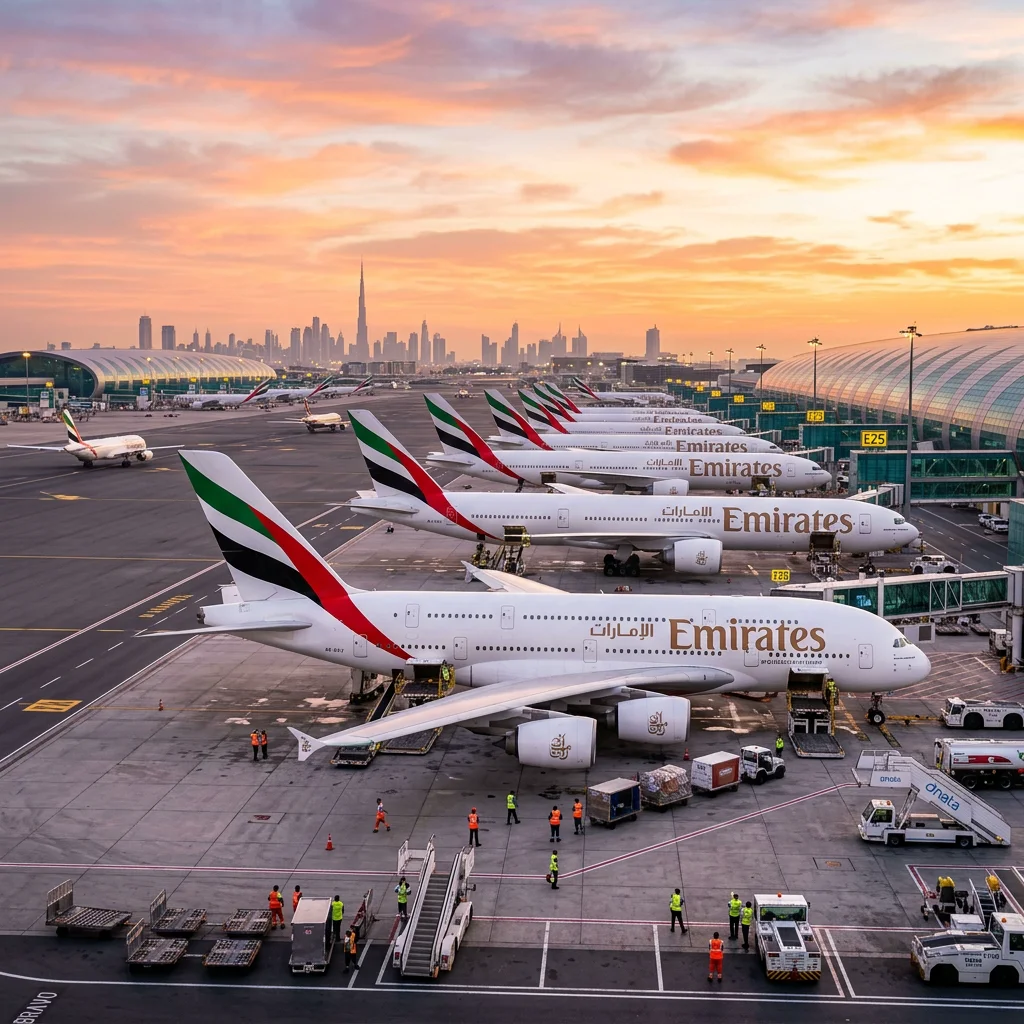
DUBAI, UAE — Following the lifting of all precautionary restrictions on UAE airspace, Dubai Airports has announced a strategic ramp-up of operations at Dubai International (DXB). The move signals the beginning of a critical recovery phase for the global aviation hub after a period of significant regional disruption.
Strategic Restoration of Flight Schedules
As of Monday morning, Dubai Airports confirmed plans to increase daily flight movements, allowing airline partners—including Emirates and flydubai—to progressively restore their standard schedules. While UAE airspace is now fully open, officials noted that capacity remains contingent on the availability of regional flight paths in neighbouring territories.
Since March 1, flights have been restricted to specific "safe air corridors." Dubai Airports is currently working with regional authorities to optimise traffic flow across the Middle East to bypass remaining constraints.
The Impact of Regional Conflict
The aviation sector faced a sudden downturn following the outbreak of the US-Israel-Iran conflict on February 28, 2024. The subsequent closure of the Strait of Hormuz led to a critical jet fuel shortage, stalling the momentum of a record-breaking growth period. In 2025, DXB welcomed a historic 95.2 million passengers; however, the recent crisis has heavily impacted early 2026 figures.
Q1 2026 Performance Metrics:
- Total Passengers: 18.6 million (Down 20.6% year-on-year)
- March Passenger Traffic: 2.5 million (Down 65.7% year-on-year)
- Cargo Volumes: 399,600 tonnes (Down 22.7%)
- Aircraft Movements: 88,000 (Down 20.8%)
Resiliency Through the 'oneDXB' Network
Paul Griffiths, CEO of Dubai Airports, characterized the recent weeks as "unprecedented" for the industry. He emphasized that the hub’s ability to sustain operations—handling 6 million passengers and 213,000 tonnes of cargo between February 28 and April 30—was due to the seamless coordination of the ‘oneDXB’ network.
"International transfer traffic through the Middle East accounts for a major share of global air travel," Griffiths stated. "Maintaining smooth operations here is critical to keep global journeys moving. Our collective response has sharpened our ability to adapt at pace."
Market Outlook
Despite the downturn, India remains the top source market for DXB with 2.5 million passengers in Q1, followed by Saudi Arabia, the United Kingdom, and Pakistan. London continues to hold its position as the busiest city destination.
As regional stability begins to normalize, Dubai Airports remains positioned to accommodate the anticipated surge in returning demand, leveraging its infrastructure to reclaim its status as the world’s busiest international gateway.