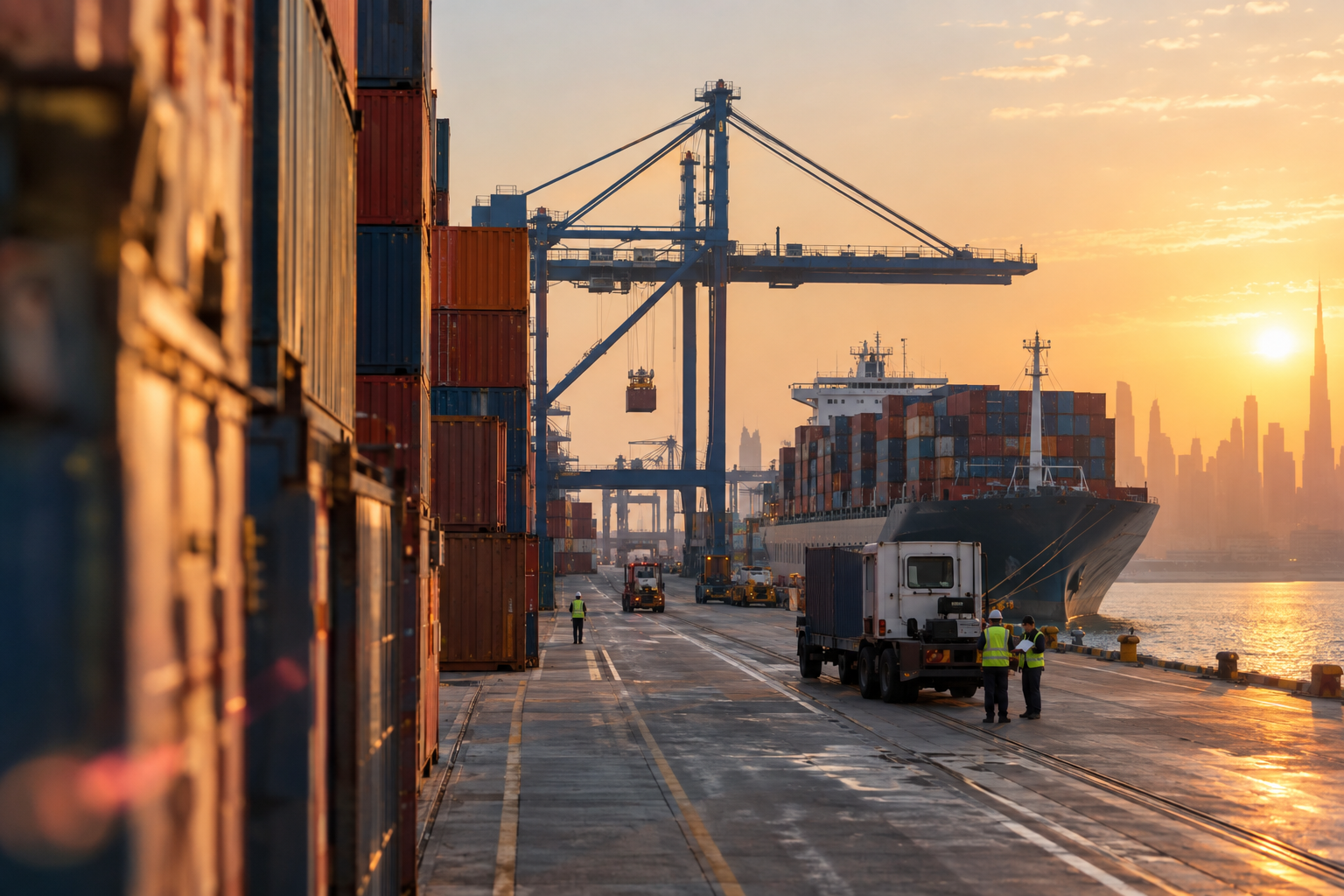
The headline number came out of Dubai in July, and it was hard to miss: the UAE's non-oil foreign trade hit Dh1.937 trillion in the first half of 2026, up 13.1 percent on the same period last year and closing in on the Dh2 trillion mark the government set as a target for the full year, according to figures released by the UAE Ministry of Foreign Trade and Dubai Media Office. Non-oil exports did even better, jumping almost 24 percent to a record Dh452.8 billion.
Those two numbers alone made most of the headlines. What matters more if you run a company that sources goods from Asia, ships to the GCC, or re-exports through a Dubai free zone is what sits underneath them: which sectors actually grew, who the UAE is trading with, how Dubai's own customs and chamber data lines up with the national picture, and where the friction points still are. That is what this piece works through, using the primary disclosures from Dubai Customs and Dubai Chamber of Commerce alongside the federal trade release.
The Headline Numbers, in Context
Dh1.937 trillion is not a one-off spike. It builds on a run of consecutive half-year records, and the UAE government has been explicit that it is measuring progress against a five-year plan to double non-oil trade. Here is how the last five first-half readings compare, based on the government's own year-on-year comparisons published alongside the H1 2026 figures.
| Period | Non-oil trade | YoY growth |
|---|---|---|
| H1 2022 | ≈ Dh1.08 trillion | base year |
| H1 2023 | ≈ Dh1.25 trillion | +54.5% vs H1 2026 gap |
| H1 2024 | ≈ Dh1.39 trillion | +39.6% vs H1 2026 gap |
| H1 2025 | Dh1.728 trillion | base for H1 2026 comparison |
| H1 2026 | Dh1.937 trillion | +13.1% |
Figures for H1 2022 to H1 2024 are derived from the percentage gaps the Ministry of Foreign Trade published relative to H1 2026 (39.6 percent above H1 2024, 54.5 percent above H1 2023, 78.8 percent above H1 2022); only H1 2025 and H1 2026 were released as absolute totals.
Exports are carrying more of the load
The more interesting shift is in the mix. Non-oil exports made up 23.4 percent of total non-oil trade in H1 2026, up from 21.3 percent a year earlier, 18.4 percent in 2024 and 16.9 percent in 2023, according to The National's reporting on the release. Thomas Kuruvilla, managing partner at Arthur D. Little for the Middle East and India, told Khaleej Times that the shift signals the UAE's diversification push has moved from ambition to a measurable, structural change in how the economy actually trades.
What Is Actually Moving: The Sector Breakdown
Gold remains the single largest commodity by value, and its growth rate outpaced almost everything else. Telecoms equipment, jewellery, cars and diamonds rounded out the rest of the top five; gold accounted for roughly two-thirds of total non-oil merchandise trade.
| Commodity | H1 2026 value | YoY growth |
|---|---|---|
| Gold | Dh706.2 billion | +48.8% |
| Telecommunications equipment | Dh189.7 billion | not disclosed |
| Gold jewellery | ranked 3rd (value not disclosed) | not disclosed |
| Automobiles | ranked 4th (value not disclosed) | not disclosed |
| Diamonds | ranked 5th (value not disclosed) | not disclosed |
● If you sell into or source from the gold, jewellery or telecoms hardware trade, Dubai's re-export infrastructure (DMCC for gold and diamonds, the free zones for electronics) is where the volume is concentrating. That is also where documentation demand, certificates of origin and customs turnaround times matter most operationally. ● The value gaps for gold jewellery, automobiles and diamonds were not broken out in the federal release. Treat the ranking as directional, not a precise share of trade, until Dubai Customs or the Ministry publishes the full commodity table.
Who the UAE Is Trading With
China stayed the UAE's largest trading partner, with non-oil trade worth Dh180.7 billion in H1 2026, ahead of Switzerland at Dh138.4 billion and India at Dh107.5 billion, per the same Ministry release. Egypt, Oman and Hong Kong posted some of the fastest growth rates among the top partners, though the release did not disclose their absolute totals.
The UAE's network of Comprehensive Economic Partnership Agreements, or CEPAs, is doing real work here. Trade with CEPA-partner countries reached Dh304.3 billion in H1 2026, of which Dh66.1 billion was non-oil exports and Dh193.5 billion was imports, according to The National. Non-oil exports now represent 21.7 percent of UAE trade with CEPA partners, up from 19.1 percent in 2022. For a founder deciding which market to prioritise next, a signed CEPA is a reasonable proxy for lower friction: faster tariff phase-downs and, in several agreements, simplified rules of origin.
India's relationship with Dubai specifically is worth flagging on its own. Non-oil trade between Dubai and India reached a record Dh222.5 billion in 2025, up 15 percent year on year, and bilateral trade has grown 136.2 percent since 2016, according to figures Dubai Chamber of Commerce released alongside its H1 2026 Indian membership update. India is now Dubai's second-largest trading partner, and the chamber registered 7,579 new Indian member companies in H1 2026 alone, taking the total to 85,841 active Indian members by June.
Dubai's Own Numbers: Customs and Logistics
The federal figures cover the whole country, but Dubai Customs also released emirate-level data for H1 2026 that is arguably more useful for anyone actually moving freight through the city.
Hatta crossing volumes nearly tripled
Trade through the Hatta Customs Crossing, Dubai's overland gateway toward Oman, surged 175 percent year on year to more than Dh37.08 billion in H1 2026, up from Dh13.48 billion in H1 2025, according to Dubai Customs data reported by Gulf News. Loaded truck traffic through the crossing rose 160.1 percent to 108,811 vehicles. Dubai Customs credited its Green Corridor initiative, an expanded base of licensed logistics providers and the Shahin electronic seal tracking system, which was used on 7,870 trucks during the half.
The scale of that jump reflects shifting regional trade routes as much as organic Dubai demand, but the practical takeaway for founders is the same either way: overland freight through Hatta is a materially faster-growing corridor than it was a year ago, and Dubai Customs has been actively investing in the systems (digital seals, expanded logistics licensing) that make it usable at scale.
Air cargo transactions up 53 percent
Dubai Customs' Air Cargo Centres Management processed approximately 18.2 million customs transactions in H1 2026, up almost 53 percent from around 11.9 million in H1 2025, with total shipment weight climbing 47 percent to roughly 1.3 million tonnes, per Dubai Customs figures reported by Economy Middle East. The Free Zone Department in air cargo alone completed 17.7 million transactions, up 62 percent, tracking e-commerce and parcel volumes rather than traditional bulk freight.
The Chamber's Own H1 2026 Update
Dubai Chamber of Commerce has historically published a dedicated H1 members' exports and re-exports figure each year (Dh171.9 billion in H1 2025, up 18 percent; Dh137.6 billion in H1 2023). As of this article's publication date, that specific H1 2026 export and re-export release had not appeared on the chamber's newsroom. What the chamber has published for H1 2026 is its public-private advocacy update, covered below. The most recent chamber-member export figure available at time of writing is the H1 2025 number, shown for trend context only and clearly labelled as such. This article will be updated, or a follow-up filed, once the chamber's H1 2026 export and re-export figure is released.
EDITOR'S NOTE
What Dubai Chamber of Commerce did confirm for H1 2026 is its regulatory advocacy work. The chamber reviewed 42 laws and draft laws in cooperation with its Business Groups during the first half, up around 56 percent year on year, with the adoption rate for private sector recommendations rising to 73 percent from 60 percent in H1 2025, according to the chamber's own release. It also held 94 meetings with Business Groups and Business Councils and launched three new sector groups: the Dubai Contractors Business Group, the Holiday Homes Business Group, and the Dubai Construction Technology Business Group.
For context on the trajectory, chamber members' combined exports and re-exports hit a record Dh356.5 billion for full-year 2025, up 15.1 percent on 2024, with 71,830 new member companies joining and active membership reaching 292,486. If H1 2026 member exports track anywhere near the pace of the federal non-oil trade growth (13.1 percent) or the chamber's own recent quarters (16 to 18 percent), the figure due for release would land somewhere in the Dh195 billion to Dh203 billion range. That is an estimate built from the growth trend, not a confirmed number, and should be read as such until the chamber publishes it.
What This Means for Founders
Put together, the H1 2026 data points to three things worth acting on rather than just reading about.
1. Export documentation demand is a leading indicator
Certificate of Origin volumes have tracked closely with trade growth in every chamber release going back to 2021. If your business exports or re-exports physical goods through Dubai and you have not already streamlined your Certificate of Origin process through the chamber's digital services, this is the time to do it: processing queues tend to lengthen as volumes climb.
2. CEPA markets are the lower-friction expansion targets
With 27 CEPA partners now in force or in progress and non-oil exports to those markets growing faster than the UAE's overall export base, a CEPA partner is a reasonable first filter when picking the next export market. India, in particular, combines a signed CEPA with the fastest-growing foreign business community inside Dubai Chamber's own membership base.
3. Hatta is no longer a niche corridor
A 175 percent jump in a single half is large enough that any founder moving freight overland toward Oman or using Hatta as an alternative route should factor the corridor's expanded capacity, digital seal system and additional licensed logistics providers into routing decisions rather than defaulting to sea or air by habit.
Quick reference: H1 2026 vs H1 2025
- UAE non-oil trade: Dh1.937 trillion, up 13.1%
- UAE non-oil exports: Dh452.8 billion, up 23.9%
- Dubai Hatta crossing trade: Dh37.08 billion, up 175%
- Dubai air cargo customs transactions: 18.2 million, up 53%
- Dubai Chamber laws/draft laws reviewed: 42, up approximately 56%
- Dubai Chamber private-sector recommendation adoption rate: 73%, up from 60%
None of this changes the fundamentals of running an import or export business in the Gulf, but it does confirm the direction of travel: more trade, a higher share of it in exports rather than imports, faster growth through Dubai's overland and air corridors, and a chamber that is actively lobbying regulators on the private sector's behalf at a higher success rate than a year ago. The next data point to watch is Dubai Chamber's own H1 2026 exports and re-exports figure, which should land in the coming weeks and will be the cleanest read yet on how much of the national growth is actually running through Dubai-based companies rather than the wider federation.
Read Also
• September Funding Pace vs H1 2026: What DSD's Own Deal Archive Says About the MENA Slowdown
• DIFC vs ADGM: Comparing the Two Gulf Free Zones' Record 2026 Numbers