The Land Rush Nobody's Talking About
Dubai Land Department data released on August 4 shows developers spent AED125 billion buying land across 7,981 transactions between January and July 2026. That land activity accounted for only 8 percent of the 99,900 total real estate sales transactions recorded over the same period, yet it made up 39 percent of the total AED321 billion in sales value. In plain terms, land deals are rare compared to unit sales, but each one carries an outsized price tag. The pace works out to roughly 1,140 land transactions a month, worth about AED17.8 billion monthly.
That imbalance is the story. Most real estate coverage tracks completed unit sales, which reflect decisions buyers made months or years ago when a project first launched. Land purchases reflect decisions developers are making right now about where the next cycle of building will happen.
Land purchases are the earliest, longest-horizon signal in real estate. A developer buying land today is pricing in demand three to five years out, before construction, financing, or a single unit goes on sale. That makes this dataset a leading indicator, not a lagging one, unlike most of the transaction volume figures that dominate property headlines.
The Leaderboard: Who Is Buying Where
The area-by-area breakdown is where the data gets genuinely surprising. Here is the full top 10 by land sales value for January through July 2026.
| Rank | Area | Land Sales Value | Transactions |
|---|---|---|---|
| 1 | Me'aisem 2 | AED 10.4 billion | 544 |
| 2 | Al Yalayis 5 | AED 7.14 billion | 907 |
| 3 | Al Ruwayyah 1 | AED 6.3 billion | 3 |
| 4 | Palm Jebel Ali | AED 5.7 billion | 140 |
| 5 | Umm Suqeim 1 | AED 4.6 billion | 30 |
| 6 | Al Yalayis 1 | AED 4 billion | 177 |
| 7 | Me'aisem 1 | AED 3.2 billion | 229 |
| 8 | Sheikh Mohammed Bin Rashid Gardens | AED 3 billion | 119 |
| 9 | Palm Jumeirah | AED 2.4 billion | 44 |
| 10 | City of Arabia | AED 2.25 billion | 20 |
Why Me'aisem 2 and Al Ruwayyah 1 Are the Real Story
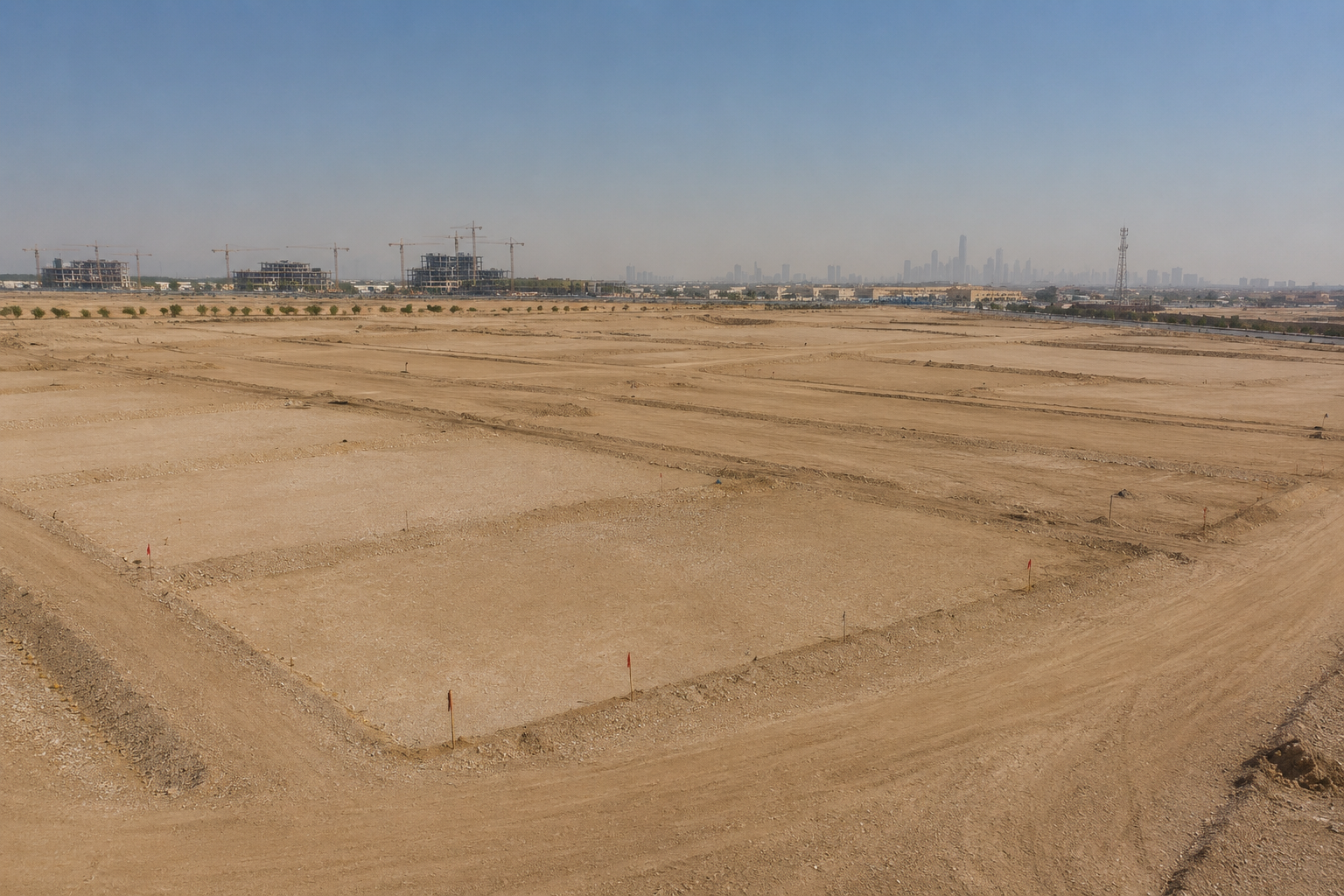
Me'aisem 2 sits within Dubai Production City, the Dubai Holding and TECOM Group corridor along Sheikh Mohammed Bin Zayed Road. Unlike its neighbor Me'aisem 1, which already holds most of the area's completed apartment blocks, Me'aisem 2 remains largely open land, positioned for future villa and apartment expansion. Developers are not paying a premium for an established address here. They are paying to secure ground ahead of a build-out that has not started yet.
Al Ruwayyah 1 tells a different kind of story. It is a land-heavy district in eastern Dubai, near Academic City and Dubai Silicon Oasis, that sits in transition between residential and logistics use. Its AED6.3 billion in land sales came from just three transactions, an average of roughly AED2.1 billion per deal. Compare that to Al Yalayis 5, which needed 907 separate transactions to reach a similar AED7.14 billion. Both areas rank in the top three by value, but one reflects a handful of large institutional land plays, and the other reflects broad, distributed buying activity across hundreds of smaller deals. The leaderboard alone does not show that difference. The transaction counts do.
Al Ruwayyah 1 needed just 3 transactions to bank AED6.3 billion. Al Yalayis 5 needed 907 transactions to reach a comparable AED7.14 billion. Same value tier, completely different buyer profile.
The Established Names Barely Register
Palm Jumeirah, Dubai's most recognizable luxury address, ranks ninth on the list with AED2.4 billion across just 44 transactions. Downtown Dubai and Dubai Marina do not appear in the top 10 by land sales value at all. That is not a sign those addresses are losing relevance. Palm Jumeirah remains close to fully built out, so there is simply little raw land left there to buy. It is a reminder that land banking activity, unlike unit sales, concentrates in corridors that still have space to build on, which increasingly means the city's edges rather than its established core. That pattern lines up with a wider infrastructure story DSD has tracked this year. Dubai's Metro Blue Line hit its first major construction milestone in July, and transport investment of that scale tends to shift where developers want to hold land well before a single station opens.
READ ALSO
→ Dubai Property Transactions Hit AED419.9 Billion in H1 2026 as Off-Plan Offices Break Records
→ Dubai's Property Market Just Grew Up: Long-Term Living Is Now the Real Growth Engine
→ Dubai Off-Plan Apartment Sells for Dh166 Million as Ultra-Prime Demand Holds Firm
What This Means for Founders and Investors
For a B2B audience weighing where to set up an office, open a storefront, or place investment capital, developer land buying is one of the earliest public signals available for where population density, retail footfall, and infrastructure spending will land three to five years from now, well ahead of any of that showing up in office rents or footfall data. Brokerages including Edwards and Towers are already framing this pace of land buying as one of several structural signals pointing toward a stronger second half of 2026, as buyers and investors return from the summer lull in September and October. Land purchased now becomes the launches, and eventually the completed communities, that define where Dubai's next growth corridor actually sits.