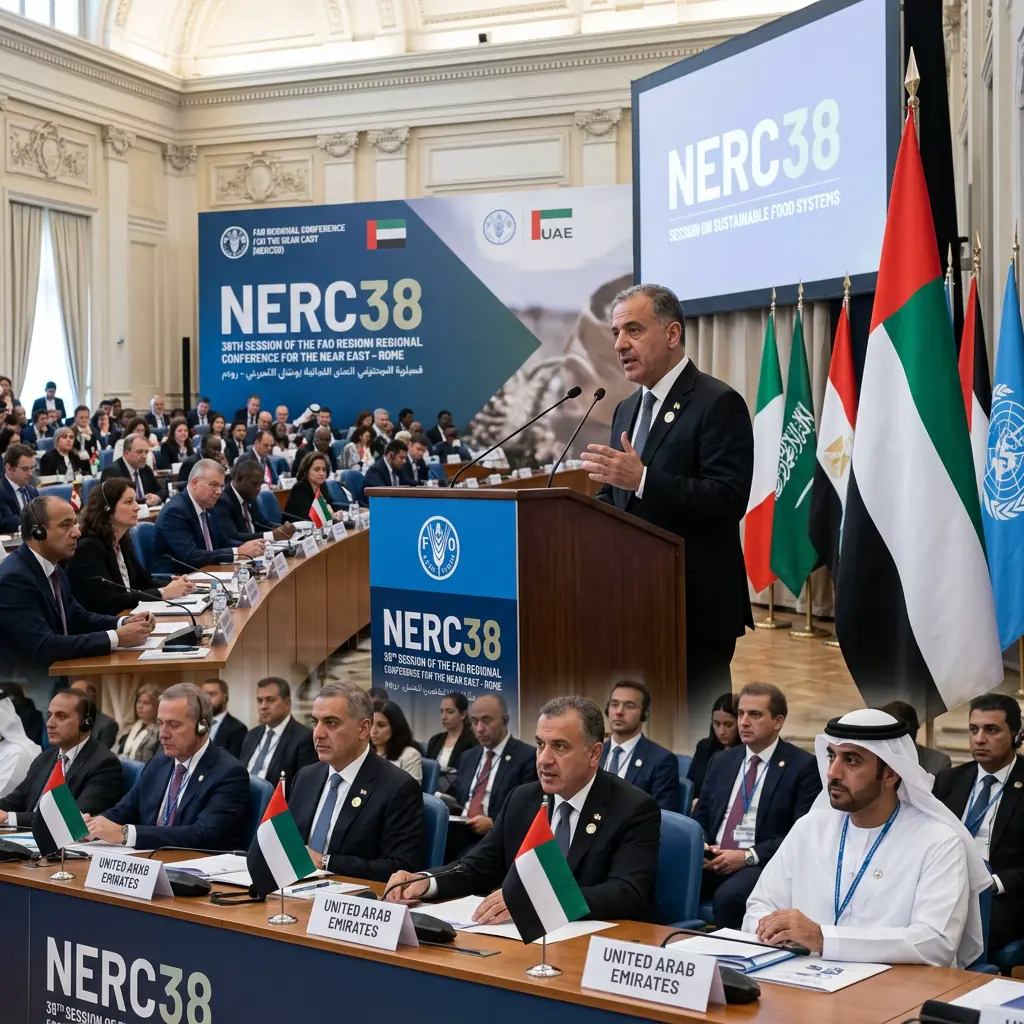
ROME — At the 38th session of the Food and Agriculture Organization (FAO) Regional Conference for the Near East and North Africa (NERC38) in Rome, the UAE delivered a decisive message: food security is a sovereign pillar of national security that requires "proactive and adaptive strategies" to withstand the shocks of a volatile geopolitical landscape.
Serving as Chair of the session, the UAE called for immediate global action to protect supply chains, specifically emphasizing that freedom of navigation is non-negotiable for the stability of agricultural inputs like fertilizers and fuel.
Navigation: The Silent Engine of Food Production
The conference highlighted a critical vulnerability in the global food system: the dependency on strategic maritime corridors. Discussions centered on the Strait of Hormuz, a vital artery through which approximately 30% of the world’s fertilizer trade flows.
The Domino Effect of Disruptions:
- Geopolitical Tensions: Instability in maritime routes leads to immediate spikes in insurance and shipping costs.
- Input Inflation: Higher costs for fertilizers and energy directly increase the price of agricultural production.
- Yield Contraction: When fertilizers become unaffordable, crop yields decline, leading to a contraction in global grain supplies.
Turning Scarcity into Innovation
Dr. Amna bint Abdullah Al Dahak, UAE Minister of Climate Change and Environment, shared how the UAE transformed its own geographical challenges—water scarcity and limited arable land—into catalysts for technological advancement, such as the rise of vertical farming in the region.
"This session comes at a critical moment that calls on the region to move beyond crisis management and assume an active role in driving meaningful, lasting transformation," Dr. Al Dahak stated.
The UAE Strategy for Resilience:
- Nature-Based Solutions: Protecting ecosystems is no longer just an environmental goal but a "profitable investment" that offers rewarding economic returns.
- Climate Finance Reform: Calling for a decisive shift in financing to support rural populations and women, who absorb the heaviest losses from climate shocks.
- Circular Bioeconomy: Encouraging the region to adopt circular solutions in agricultural value chains to minimize waste and maximize resource efficiency.
Proactive Governance and Market Stability
Mohammed Saeed Al Nuaimi, Undersecretary of the Ministry of Climate Change and Environment, outlined how the UAE uses its world-class logistics infrastructure to maintain domestic market stability. By diversifying import sources and building a broad network of international partnerships, the UAE has created a "national system with operational flexibility."
To support this, the UAE suggested that the FAO develop early warning systems—similar to an "Observatory"—to monitor food, energy, and fertilizer markets, allowing countries to predict and contain shocks before they manifest.
Empowering the Next Generation
The UAE delegation also spotlighted the role of youth in revolutionizing the agricultural sector. Rather than seeing young people merely as beneficiaries, the UAE advocates for young entrepreneurs using innovative startup financing to bring climate-smart solutions to market.
The NERC38 Ministerial Meeting concluded with a regional consensus to develop a comprehensive roadmap under the UAE’s Presidency, shifting from "diagnosing challenges" to "coordinated implementation."