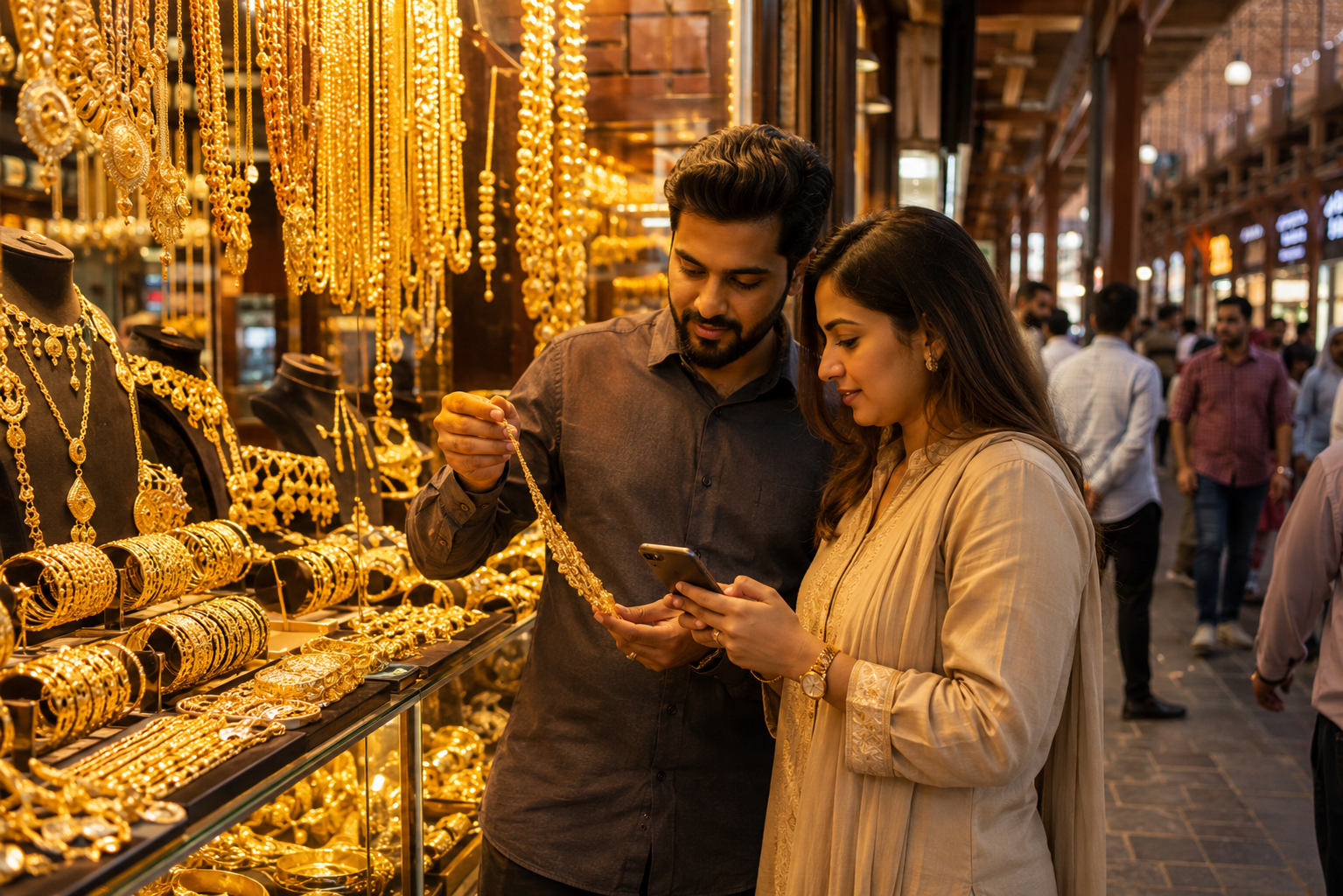
Eid is almost here, and if you're planning a gold purchase, whether a piece of jewellery for a loved one or a bullion investment, one question matters more than ever: Does Dubai still offer better value than India? After major policy shifts in both markets, the answer is a clear yes. Here's exactly why.
What Changed in India?
India has made gold considerably more expensive for its own citizens. As of May 13, 2026, the government raised customs duty on gold imports from 6% to 15%, a significant jump that passed almost immediately into retail prices at jewellery shops across Mumbai, Delhi, and beyond.
On top of that, the Indian Rupee has depreciated roughly 7% against the US Dollar this year alone. Since gold is globally priced in USD, every rupee lost in value pushes the local gold price higher. The combined impact has been a 20% year-to-date rally in Indian domestic gold prices, a painful reality for local buyers.
Analysts at ICICI Bank Global Markets warn this is not a short-term blip. Their latest report projects Indian gold to trade between ₹1,50,000 and ₹1,80,000 per 10 grams through the rest of 2026, rising further to ₹1,60,000–₹1,90,000 in 2027, assuming a USD/INR rate of around 96.
Current Gold Prices at a Glance
| Gold Purity | UAE Retail Price (per gram) | India Price (per 10 grams) |
|---|---|---|
| 22K Gold | Dh 504.75 | ₹ 1,45,650 |
| 24K Gold | Dh 545.25 | ₹ 1,58,890 |
Why Dubai Holds the Edge
Dubai's structural advantages as the 'City of Gold' are well-founded. Three key factors keep UAE gold prices competitive:
- Low Taxes. A much lower tax environment compared to India's combined 15% customs duty plus GST structure.
- Currency Stability. The UAE Dirham is pegged to the US Dollar, shielding local buyers from the currency-driven price inflation that is hammering India.
- Transparent Market Pricing. UAE retail prices move closely with international spot prices, meaning any global dip is passed on to consumers almost immediately.
Shifting Consumer Behaviour
India's gold import values surged 81% in April 2026, but the headline is misleading. The jump reflects higher asset prices, not a boom in physical demand. Physical volumes into India actually fell sharply to around 30 tonnes per month in March and April, compared to a 50-tonne monthly average in 2025.
Meanwhile, cross-border buyers are increasingly looking toward the Gulf. Travellers who purchase gold in Dubai and carry it back to India must remain compliant with customs declaration rules and duty-free limits. However, the net savings on plain jewellery, coins, and investment bars purchased in Dubai's Gold Souk continue to outweigh the regulatory friction for most informed buyers.
Global Gold Outlook: Still Bullish
Globally, gold remains in a structural bull cycle. Institutional analysts forecast near-term spot prices in the $4,400–$4,600/oz range. Longer-term projections are even more bullish: $4,800–$5,000/oz by December 2026 and a potential $5,400–$5,600/oz by end-2027, driven by central bank accumulation and continued safe-haven demand.
Brief corrections toward $4,200/oz are possible if geopolitical tensions in West Asia ease significantly, but the broader trend remains firmly upward.
The Verdict for Eid Shoppers
For expats and travellers prioritising value, variety, and transparent pricing, the UAE offers a demonstrably superior purchasing proposition this Eid. Whether you're buying investment gold or jewellery for a family celebration, Dubai's lower tax burden and stable currency make it the smarter choice, and the data backs it up.
| ✦ India raised gold import duty from 6% to 15% in May 2026, pushing retail prices sharply higher. |
| ✦ The Indian Rupee's 7% depreciation this year has compounded gold price inflation for Indian buyers. |
| ✦ Dubai gold tracks USD spot prices closely, with no major duty burden keeping it 15–20% cheaper than India. |
| ✦ Indian gold prices are forecast to reach ₹1,50,000–₹1,80,000 per 10g through end-2026. ✦ Global gold is projected to hit $4,800–$5,000/oz by December 2026 and $5,400–$5,600 by end-2027. |