Ask most parents in the UAE about medical school abroad and the response tends to follow a familiar script: it is expensive, it takes forever, the entrance exams are brutal, and the odds of getting in straight from high school are low. A session at the Gulf News Edufair Abu Dhabi 2026 challenged all four of those assumptions.
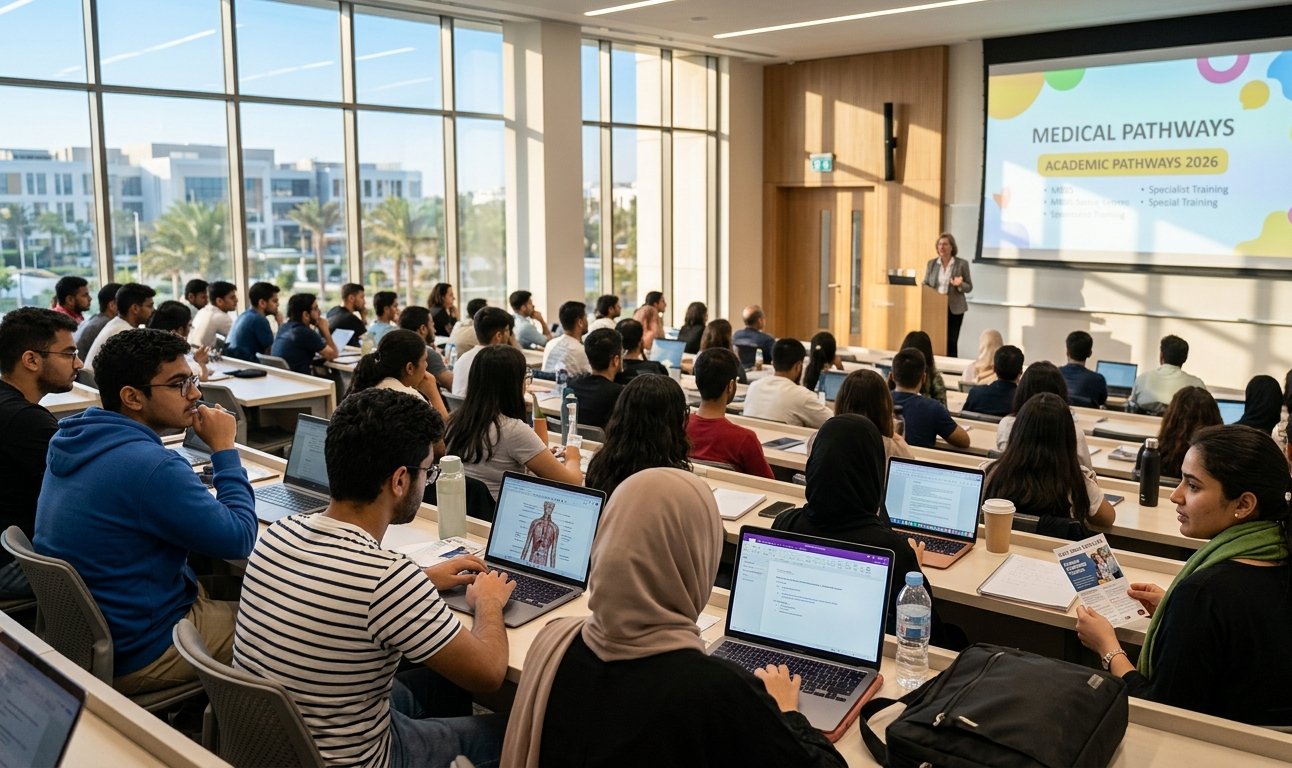
The panel, titled Choosing the Right Medical Pathways after Grade 12, was held at the Radisson Blu Hotel and Resort on Abu Dhabi Corniche. The featured speaker was Isha Bhandari, Regional Manager for the Middle East and North Africa at GEDU Global Education. Her message was direct: the traditional model of medical education is being reorganised, and UAE students are better positioned to access global programmes than many families realise.
The session brought together prospective medical students and parents eager to understand what international medical education actually looks like in 2026, not what it looked like a decade ago.
Breaking Down the Traditional Model
The standard American medical track has long followed what is known as the 4+4 model. Students spend four years completing an undergraduate degree with a pre-medical focus, sit the highly competitive Medical College Admission Test, and then spend another four years in medical school. Total timeline: eight to nine years, with no guarantees.
That model has not disappeared. But it is no longer the only option.
Integrated six-year medical programmes combine pre-medical foundations and clinical medicine into a single curriculum, cutting the total time to qualification by two to three years and significantly reducing overall tuition costs.
No Entrance Exam: How That Is Even Possible
One of the most eye-catching points Bhandari made was that some of these integrated programmes do not require a dedicated entrance exam. For students who might struggle with the MCAT or similar high-stakes tests, this is a meaningful distinction.
The criteria instead focus on consistent, high-level performance in Biology and Chemistry at Grade 12. Bhandari drew a useful comparison:
For our integrated pathways, there is no entrance exam required to enter the university. The primary academic criteria focus entirely on consistent, high-tier performance in Biology and Chemistry at the Grade 12 level. Students entering business or computer science go straight from their senior-year marks. Science students deserve the same clarity.
The US Board Certification Question: Read the Fine Print
This is where Bhandari's advice became most practically valuable, and most urgent. Not all international medical degrees automatically qualify a graduate to sit US board licensing exams, a fact that many families only discover after significant financial and time investment.
For a student aiming at a US residency and career, the accreditation structure of the programme matters far more than the name on the certificate. Specifically, hands-on clinical experience inside US teaching hospitals is non-negotiable for building a competitive residency portfolio.
A common model discussed at the session involves completing basic sciences on an international campus, such as in the Bahamas, before moving to the United States for the final two years of clinical clerkships and hospital rotations. That US clinical exposure is what opens the door to residency matching.
How UAE Family Attitudes Are Shifting
The interactive format of the session revealed something important about where UAE families are in their thinking. Western medical education used to be viewed as financially out of reach for many households, and the entry barriers reinforced that perception. That is changing.
Six-year integrated programmes, clearer accreditation pathways, and better access to information are making global medical education feel more navigable. Families that once dismissed the idea are now asking specific questions about costs, timelines, and post-graduation outcomes.
Bhandari's closing message was practical:
Do your research. Use digital resources to fully understand which country provides the optimal environment for your long-term medical practice. It is about identifying the correct regional alignment for your career goals.
Before committing to any international medical programme, independently verify the institution's accreditation status with the relevant regulatory body in the country where you intend to practise. Accreditation information is publicly available and should be the first thing any family checks.