
Hiring your first few people as a UAE startup founder is one of those things that seems simple until you are actually doing it. You post a role, find a great candidate, and then suddenly you are navigating work permit categories, visa quotas, Emiratisation thresholds, and mandatory health insurance obligations at the same time. None of these is impossible to manage. But you need to know what is coming before it lands on your desk. This guide covers the full picture for hiring in the UAE in 2026 and what startup founders actually need to prioritise.
📖 Read Also: UAE Fintech Startup Landscape 2026: Key Players, Funding, and Regulatory Environment
First, Free Zone or Mainland? This Affects Everything
Before you hire your first person, the structure of your company determines what hiring rules apply to you. This is the fork in the road that most founders do not think about until it matters. According to RemotePass's breakdown of free zone versus mainland hiring, the two setups operate under notably different rule sets.
Mainland companies handle employment through MOHRE. That means work permits, employment contract registration, Wages Protection System (WPS) compliance, and Emiratisation quotas all apply to you. Free zone companies process visas through their own free zone authority instead of MOHRE, and are currently exempt from mandatory Emiratisation requirements. That is a significant difference for an early-stage startup with a lean team.
The trade-off: free zones are cheaper and simpler to set up and manage in the early stages. But mainland companies have direct access to the UAE domestic market, can sign government contracts, and are not limited by zone-specific activity lists. Where you eventually want to sell shapes, which structure makes sense for you?
• Mainland: MOHRE processes work permits; free zone: own authority handles it • Mainland: Emiratisation quotas apply from 20 employees (in 14 sectors) or 50+ employees • Free zone: currently exempt from mandatory Emiratisation targets • Mainland visa quota: tied to your office Ejari (roughly 1 visa per 9 sq.m of space) • Free zone visa quota: typically bundled into your package (flexi-desk = 1 to 6 visas) • Both structures require WPS salary compliance and mandatory health insurance
How the Employment Visa Process Actually Works
Once you decide to hire someone, the process follows a mandatory sequence. You cannot skip steps, and the employer carries the cost of all of it. According to the Dubai Business Services employment visa guide for 2026, a standard 2-year employment visa costs between AED 3,500 and AED 7,000 depending on your MOHRE company classification, and the full process takes 2 to 4 weeks.
Step-by-step: What happens when you hire someone in the UAE
- Step 1: Apply for the work permit via the MOHRE Tas'heel portal (or free zone authority). Submit a passport copy, photos, educational certificates, and a signed offer letter. Approval takes 2 to 5 working days.
- Step 2: Issue an Employment Entry Permit (the "pink visa"). The employee enters the UAE within 60 days of this being issued.
- Step 3: Employee signs the MOHRE-registered employment contract within 14 days of arrival.
- Step 4: Employee completes the mandatory medical fitness test (blood test and chest X-ray at a DHA-approved centre).
- Step 5: Biometric data collection for Emirates ID. Allow 5 to 10 working days for processing.
- Step 6: The employer arranges mandatory health insurance before visa stamping is completed.
- Step 7: The residence visa is issued and linked to the Emirates ID. Employee is now legally employed.
- Fast-track option: Pay an extra AED 500 to AED 1,000 to compress the process to 5 to 7 working days.
One rule that catches founders off guard: under Federal Decree-Law No. 33 of 2021, the employer pays 100 percent of all visa and permit costs. You cannot deduct these fees from an employee's salary. It is illegal to do so.
What It Actually Costs to Hire Someone
Founders who budget only the base salary consistently underestimate the true cost of a hire in the UAE. The Multiplier Dubai hiring guide puts total hiring costs at 1.25 to 1.4 times the base salary when you account for mandatory benefits, visa costs, health insurance, and end-of-service gratuity. Here is how that breaks down:
| Cost Item | Typical Range (AED) | Notes |
|---|---|---|
| Work permit and visa fees | 3,500 to 7,000 | Employer pays 100%; varies by MOHRE category |
| Mandatory health insurance | 500 to 800 per year | Minimum required; premium plans cost more |
| Medical fitness test | 300 to 400 | DHA-approved centres only |
| Emirates ID | Included in visa process | Processed during onboarding |
| End-of-service gratuity | 21 days salary per year (years 1 to 5) | Accrues from day one; not optional |
| Annual air ticket (common) | 2,000 to 5,000 | Standard expectation for expat hires |
| WPS-compliant salary transfer | Bank fees vary | All salaries must go through approved channels |
Gratuity is the cost most founders underestimate. It accrues from the first day of employment and applies to all employees, regardless of visa type or employment contract length. Build it into your financial model from the moment you sign your first contract.
📖 Read Also: Bootstrapping vs VC Funding vs Angel Investment: Which Path for UAE Startups in 2026?
Salary Benchmarks: What Are People Actually Getting Paid?
The UAE's zero personal income tax environment makes salary comparisons with Western markets genuinely complicated. A mid-level software engineer earning AED 22,500 per month in Dubai takes home the same amount that leaves their bank account, which the Employsome UAE salary overview notes is equivalent to roughly $135,000 gross salary in New York once you account for US federal and state income tax. That context matters when you are trying to close a hire from a competitive global market.
| Role | Entry (AED/month) | Mid-Level (AED/month) | Senior (AED/month) |
|---|---|---|---|
| Software Engineer | 12,000 to 18,000 | 22,500 to 35,000 | 40,000 to 65,000 |
| Product Manager | 15,000 to 22,000 | 28,000 to 42,000 | 50,000 to 70,000 |
| AI/ML Engineer | 15,000 to 22,000 | 25,000 to 40,000 | 50,000 to 80,000+ |
| Marketing Manager | 10,000 to 16,000 | 18,000 to 28,000 | 30,000 to 50,000 |
| Operations/Finance | 8,000 to 14,000 | 16,000 to 26,000 | 28,000 to 45,000 |
| Sales (B2B) | 8,000 to 14,000 + commission | 15,000 to 24,000 + commission | 25,000 to 40,000 + commission |
AI and GenAI roles are commanding a 25 to 40 percent premium above standard tech rates in 2026, according to UAE salary benchmarking data from Element MEA. Startup founders competing against sovereign tech groups like G42 or Mubadala for the same talent need to think carefully about how equity and career opportunity compensate for the base salary gap. In many cases, those arguments work. But they need to be made explicitly.
Emiratisation: What Early-Stage Startups Actually Need to Know
Emiratisation is one of those topics where startup founders often get either panicked or complacent, and both are the wrong response. Here is the actual picture for small teams, based on current Emiratisation compliance guidance:
Emiratisation rules by company size in 2026:
- Under 20 employees: no mandatory quota currently applies to you
- 20 to 49 employees in 14 targeted sectors: must have hired at least one Emirati by 2024 and a second by end of 2025. Fines of AED 108,000 per missing Emirati apply from January 2026.
- 50+ employees (mainland): must increase Emirati representation in skilled roles by 2% every 6 months. Target of 10% by end of 2026. Monthly fines of AED 9,000 per unfilled position.
- Free zone companies: currently exempt from all mandatory quotas. No quota to meet, no MOHRE reporting.
- From January 2026: minimum monthly salary for Emiratis in the private sector is AED 6,000.
If you are at pre-seed or seed stage with a team under 20, Emiratisation is not an immediate compliance concern. But plan for it. If your product-market fit lands and you scale past 20 employees in a targeted sector, the clock starts. Knowing what triggers the requirement means you can hire proactively rather than reactively.
📖 Read Also: Dubai Launches Agentic AI Plan to Back 295,000 Companies Across the Emirate
Where to Actually Find the Right People
The UAE talent market has a few platforms that genuinely work for startup hiring, and some that generate volume but not quality. Here is an honest breakdown:
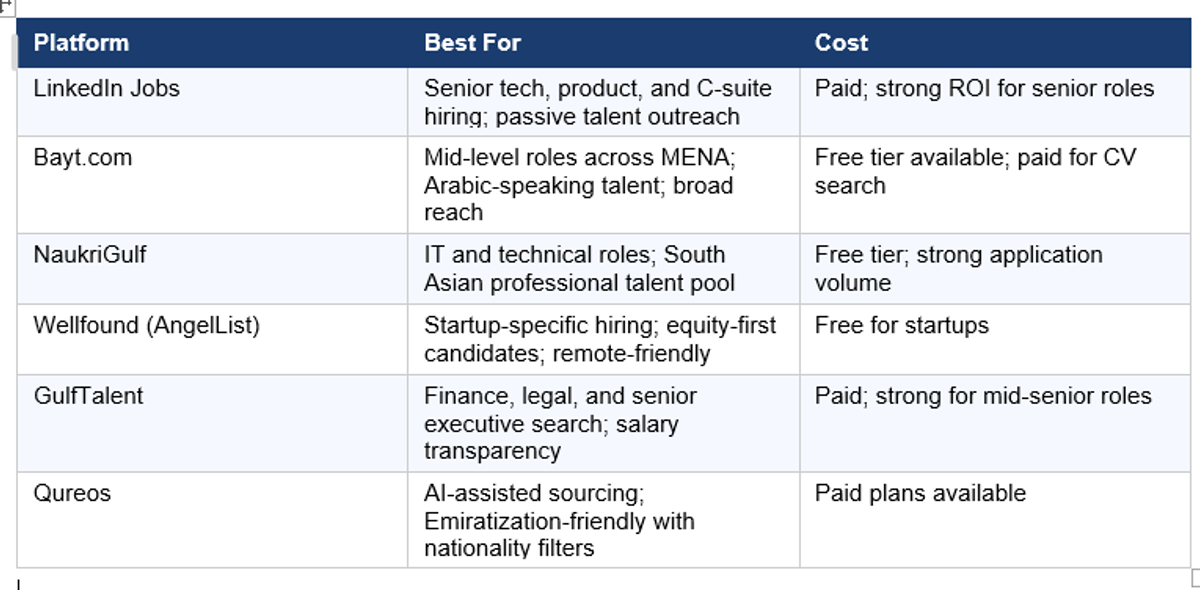
For early-stage startups, the combination that tends to work best is LinkedIn for senior or specialized roles and Bayt or NaukriGulf for mid-level and operational hires. According to Qureos' UAE platform analysis, roughly 70 percent of UAE jobs are never publicly posted. Referrals and network hires are how most strong early employees find their way to startups. Build your network inside the ecosystem before you have the role open.
📖 Read Also: Three UAE Startups Just Raised $69.2M. Here Is What They Are Building and Why It Matters.
What Actually Works: Practical Lessons from Founders Who Have Done It
Beyond the regulations, the founders who hire well in the UAE consistently do a few things differently.
What works in practice for UAE startup hiring:
- Budget the full cost, not just the salary: plan for 1.3x the gross monthly salary as your real monthly employment cost when visa, insurance, gratuity, and allowances are included.
- Use free zones for your first hires if you want speed and flexibility. Mainland is better if your customers are UAE businesses or government entities.
- Hire Golden Visa holders when you can: they do not need entry permits, medical tests, or Emirates ID processing. Onboarding a Golden Visa holder is significantly faster and simpler than onboarding a fresh expat hire.
- Equity conversations work here. The UAE now allows startups to issue Employee Stock Option Plans (ESOPs) under certain free zone and mainland frameworks. Use this to compete with bigger employers on the total package.
- Do not skip the WPS setup. All salaries must be paid through an approved UAE bank or transfer system. Missing WPS payments triggers MOHRE penalties and can freeze your ability to issue new work permits.
- Use an Employer of Record (EOR) service for your first 1 to 3 hires if you want to start quickly without entity setup. Providers like Deel or Multiplier handle contracts, visas, and payroll. Costs typically run USD 500 to USD 1,000 per employee per month.
One thing worth knowing: hiring a Golden Visa holder requires only a work permit from MOHRE. No entry permit, no medical test, no Emirates ID application. According to Masdar EOR's Golden Visa employer guide, the process is notably faster and simpler than standard expat onboarding. As the Golden Visa program expands to cover more skilled professional categories, this is increasingly relevant for startup hiring.
The Bottom Line
Hiring in the UAE as a startup founder in 2026 is genuinely manageable, but only if you understand the system before you need to use it. The visa process is more streamlined than it was a few years ago. The costs are predictable once you know what to include. The talent pool is deep, particularly for tech and finance roles. And the zero-income tax environment gives you a real advantage when closing candidates from Western markets.
The founders who get tripped up are usually the ones who underestimate the total cost of a hire, get blindsided by gratuity obligations, or do not check their visa quota before making an offer. None of those is a big problem if you plan for them. All of them are expensive if you do not.