The UAE startup ecosystem crossed a meaningful threshold in 2025. The country raised over $2 billion across 218 deals, led all MENA markets in Q1 2026 with $625.8 million across 46 deals, and now accounts for 66.5% of all regional venture capital. For founders sitting on an idea or an early product, that headline number is genuinely encouraging.
But the headline does not tell the full story. That capital is not evenly distributed. A single $550 million AI infrastructure deal from Core42 can flatter the aggregate numbers. Seed-stage founders are operating in a different market than Series B companies, and the rules are different. The investors are different. The expectations are different.
This guide is written specifically for founders who are preparing to raise their first institutional round in the UAE in 2026. It covers what seed funding actually looks like here, which investors are active, what your deck and metrics need to show, and how to navigate the process from first meeting to close.
1. What Does 'Seed Stage' Actually Mean in the UAE?
The terminology can be confusing, especially because the definitions shift by market. In the UAE, the funding ladder broadly looks like this:
- Pre-Seed: AED 200,000 to AED 1 million (roughly $55K to $270K). Friends, family, angel networks, and accelerator grants. You are funding proof of concept and early hires.
- Seed: AED 1 million to AED 10 million ($270K to $2.7M). First institutional cheques. You should have a working product, some early customers or pilot data, and a founding team in place.
- Seed Extension / Pre-Series A: AED 5 million to AED 20 million, intended to achieve the metrics necessary for Series A. This includes evidence of revenue, retention, and market expansion.
Typical seed valuations in Dubai run between $2 million and $8 million, with investment sizes between $250,000 and $1 million per investor, and founders generally giving up 10% to 25% equity. This is a lower dilution than many Southeast Asian or African markets, where perceived risk premiums push equity stakes higher.
The Middle East has quietly become one of the most active pre-seed and seed markets globally. According to 2026 data from Pitchwise, the region now boasts an average pre-seed valuation of $3.7 million, which overtook Europe on that metric. That is a reflection of two things: the quality of founders coming into the market, and the availability of sovereign-backed capital that compresses risk premiums for early-stage investors.
| UAE Q1 2026 funding | $625.8M across 46 deals |
| UAE share of MENA VC | 66.5% in Q1 2026 |
| Typical seed valuation | $2M to $8M in Dubai |
| Typical equity dilution | 10% to 25% at seed stage |
| Average pre-seed val. | $3.7M across Middle East |
| Time to funding | 90 to 150 days from first approach |
Read Also: Dubai Startup Ecosystem Report 2026: State of the Market, Key Sectors, and Investor Sentiment
2. Who Is Writing Seed Cheques in the UAE Right Now?
This is the question every founder should answer before they write a single word of their deck. The UAE investor landscape has matured significantly, but it is still more relationship-driven than deal-flow-driven. Knowing who is actively investing at seed stage, and in what sectors, will save you months.
Active Seed VCs
- Wamda Capital Evergreen, founder-led fund investing $250,000 to $2 million in seed-stage tech companies across MENA. Track record includes Careem and Souq.com. Strong preference for founders with 5 to 10 years of domain experience.
- Shorooq Partners One of the most active early-stage funds in the region. Strong in fintech, agritech, and edtech. Known for high engagement post-investment.
- Middle East Venture Partners (MEVP) $260M+ AUM. Invests from seed through Series B across Dubai, Beirut, Bahrain, and Riyadh. One of the most established regional funds.
- Plus VC Abu Dhabi-based with a strong early-stage focus. Reported 17+ investments in the 12 months to early 2026. Particularly active in AI and B2B SaaS.
- VentureSouq, a Dubai-based thematic fund active in fintech and climate tech. Portfolio includes Tabby, Volopay, and Aspire. Good for post-product startups with early traction.
- Global Ventures is a growth-stage investor covering MENA and broader emerging markets. Has been active in AI and marketplace businesses.
Angel Networks
- Dubai Angel Investors (DAI): A well-structured angel network with average seed investments around $3.31 million and typical tickets between $250,000 and $1 million. Particularly helpful for pre-revenue founders who need smart money alongside the capital.
- DIFC FinTech Hive: Not purely an angel network, but functions as a structured pipeline for fintech founders seeking both investor introductions and regulatory sandboxing. If you are building a financial product, starting here before your seed raise makes sense.
Government and Corporate Venture Programs
- Dubai Future District Fund: Backs deep tech, AI, and future economy startups with early-stage capital and government network access.
- Hub71 (Abu Dhabi): Provides funding, subsidised housing, and a global investor network. Strong ties to Mubadala, ADQ, and global partners. Worth considering if you are open to an Abu Dhabi base.
- DIFC Innovation Testing License: Not funding but enables regulated financial products to be tested in a live environment without a full licence. Valuable for fintech founders.
3. What Sectors Are Getting Funded at Seed Stage?
Broadly speaking, investors follow the macro trends. In 2026, the sectors generating the most seed-stage activity in the UAE are:
- Fintech: 46% of total UAE investment in Q1 2026. Includes payments, lending, spend management, BNPL, and crypto infrastructure. This remains the anchor sector for UAE venture capital at every stage, including seed.
- AI and B2B SaaS: AI investments across MENA tripled year-on-year in 2025. AI-native B2B SaaS companies are seeing the fastest closing timelines at seed because investors are not waiting for traction metrics they had previously required.
- Proptech: The UAE real estate market's sheer volume creates a permanent structural demand for technology. From mortgage platforms to title tokenisation, proptech has been the second-largest funded sector for two consecutive quarters.
- Logistics and E-Commerce Infrastructure: Fast-growing but competitive. Investors at seed stage are looking for real differentiation, not another last-mile delivery concept.
- CleanTech and Climate: Emerging but growing fast under the UAE Net Zero 2050 commitment. Still early in terms of active seed investors, but sovereign-linked capital is available for genuinely innovative models.
If your startup does not fit neatly into one of these categories, that does not mean you cannot raise. But it does mean you need a much sharper market-sizing argument and a more targeted investor list. Sector-agnostic VCs in the UAE do exist, but the hot capital is clearly thematic right now.
Read Also: UAE Startups Funding Roundup June 2026: This Week's Biggest Deals and What They Signal
4. What Do UAE Investors Actually Want to See?
The biggest mistake first-time founders make is assuming UAE investors think the same way as Silicon Valley VCs. They do not. Some things matter more here. Some things matter less. Getting this calibration right will change how you build your pitch.
What matters more in the UAE
- Team and network: Regional investors back founders over ideas, especially at seed. They want to know you understand the MENA market, that you have relevant domain experience, and that you have relationships that will help you move quickly. A two-person founding team with 7 years of relevant experience will beat a first-time solo founder with a slicker deck almost every time.
- Regional market relevance: UAE VCs are not just looking for good businesses. They are looking for businesses that benefit from being based in the UAE. If your product solves a problem that is more acute in the Gulf than elsewhere, lean into that explicitly.
- Clear path to regional expansion: Dubai as a beachhead into Saudi Arabia, Egypt, or broader GCC is a compelling story. Investors here understand that narrative well.
- Regulatory readiness: Particularly in fintech and health tech. Showing you understand the licensing requirements at DIFC, ADGM, or under the Central Bank of UAE framework signals maturity. Investors who have backed regulated businesses before do not want to fund founders who will spend the first year surprised by compliance requirements.
What matters less (than you might expect)
- Perfect unit economics: At seed, few UAE investors expect fully optimised LTV/CAC ratios. They want to see the direction of travel and evidence you understand the levers.
- Massive revenue: Early-stage traction matters, but a founder with $30,000 in monthly recurring revenue and 15 serious pilots under negotiation is often more compelling than one with $80,000 in MRR that they cannot explain.
The deck itself
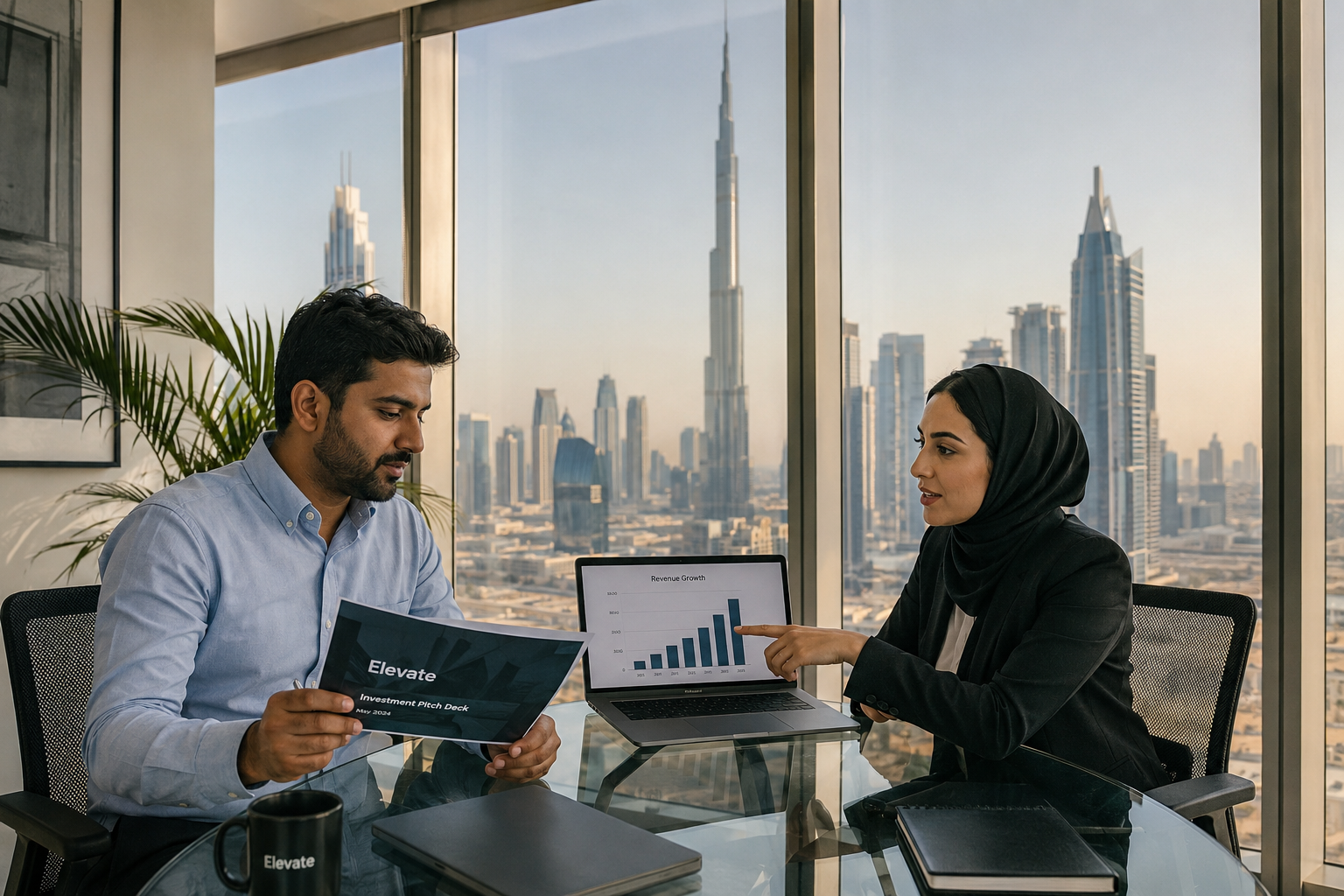
Keep it to 10 to 14 slides. UAE investors see a large volume of decks and have short attention spans in the initial review phase. The must-have slides are: problem, solution, market size (TAM/SAM/SOM, regionalized), traction, business model, competition, team, financials (3-year projections), use of funds, and the ask. That is ten slides. Anything beyond that should be in the appendix.
One note on the financials slide: UAE investors are more comfortable with AED-denominated projections than USD ones for companies operating domestically. If your revenue is genuinely USD-denominated (e.g., a SaaS product sold internationally), use USD. If your customers are paying in AED, show AED numbers. It sounds like a small thing, but currency inconsistency in a pitch deck signals unfamiliarity with your own market.
5. Structure Before You Raise: Getting Your Company Ready
Most UAE seed rounds fall apart not at the pitch stage but at due diligence. The reason is almost always the same: the company's legal structure, cap table, or shareholder agreements are not investor-ready. Sort this before you start taking meetings.
Choosing the right structure
For most startups raising institutional capital, the two serious options are DIFC incorporation and ADGM incorporation. Both offer Common Law frameworks, 100% foreign ownership, and the kind of legal credibility that makes global investors comfortable. Dubai Mainland is cheaper and more flexible for operations, but it is not the preferred structure for institutional investors who are used to DIFC or ADGM SPVs.
Read Also: DIFC vs ADGM vs Dubai Mainland: Which Business Structure Is Right for Your Startup in 2026?
Cap table hygiene
A clean cap table is a fundraising asset. A messy one is a fundraising liability. If you have taken money from friends or family before your institutional seed round, those investments should be converted to SAFEs (Simple Agreements for Future Equity) or convertible notes with clear valuation caps and discount rates. Avoid giving out equity in exchange for advice, intros, or services. Advisors should be on standard 0.1% to 0.5% advisory option pools, not on the cap table proper.
Documentation to have ready
- Certificate of incorporation and commercial licence
- Memorandum and articles of association
- Shareholder agreement (especially if you have co-founders)
- Any existing investment agreements (SAFEs, convertible notes, loan agreements)
- Employment agreements for key hires
- IP assignment agreements, confirming the company owns its own technology
- Audited or management accounts for the past 12 months (if applicable)
Investors will request all of this during due diligence. Having it ready in a clean data room from day one communicates professionalism and speeds up close. Expect due diligence to take 4 to 8 weeks once a term sheet is signed.
6. The Fundraising Process: A Realistic Timeline
The average time from first investor approach to funding close in the UAE runs between 90 and 150 days. That is 3 to 5 months. Plan your cash runway accordingly. Running out of money mid-raise is a negotiating disaster.
| Month 1 | Prep: Deck, data room, target list, warm intro strategy |
| Month 2 | First meetings, feedback, iterate deck, narrow list |
| Month 3 | Serious conversations, term sheet negotiation |
| Month 4 | Due diligence, legal docs, shareholder agreements |
| Month 5 | Close, wire, announcement (optional) |
Getting warm introductions
Cold outreach to VCs in the UAE works less often than in Western markets. The investor community is smaller and more relationship-driven. If you do not have a direct connection to a target fund, the fastest path is usually through a portfolio founder at that fund. Most VCs are far more responsive to an introduction from a founder they back than to a LinkedIn message from a stranger.
Dubai-based accelerators, particularly DIFC FinTech Hive, Flat6Labs, and in5, are useful for building these networks even if you do not formally go through their programs. Attending their demo days and events as an observer lets you build relationships before you need them.
Term sheet basics
When a term sheet arrives, pay close attention to four things beyond the headline valuation: the liquidation preference, pro rata rights, anti-dilution provisions, and board composition. UAE term sheets broadly follow international VC norms, but the specific terms vary by fund. A 1x non-participating liquidation preference is standard. Watch for participating liquidation preferences, which effectively allow investors to take their money back and then also share in upside as equity holders. That is not standard and should be negotiated out.
7. Accelerators and Government Programs Worth Knowing
If you are pre-revenue or very early, raising institutional VC may not be the right first step. Accelerators and government programs can provide non-dilutive or low-dilution capital alongside mentorship and investor introductions that de-risk the subsequent VC raise.
- Flat6Labs Dubai: One of the most active MENA accelerators with programs in Dubai. Invests $30,000 to $50,000 for 5% equity. Strong regional network.
- DIFC FinTech Hive: Accelerator specifically for fintech companies. Provides access to major banks, insurance firms, and regulators within DIFC. Invaluable for regulated product development.
- Hub71 (Abu Dhabi): Government-backed program offering up to $500,000 in incentives including subsidised housing, health insurance, and office space. Particularly strong for deep tech and AI founders.
- Mohammed Bin Rashid Innovation Fund (MBRIF): Provides financing up to AED 5 million for innovative businesses operating in or expanding to Dubai. Non-dilutive for qualifying projects.
- Dubai Future District Fund: Backs early-stage companies in future economy sectors. Combines capital with government network introductions that can be transformative for B2B founders.
8. Common Reasons UAE Seed Rounds Fail
Founders who have been through a failed raise almost always identify the same handful of reasons. Here are the most common ones, and how to avoid them.
- Raising at the wrong valuation: Asking for a $10 million pre-money valuation with $5,000 in monthly revenue is the fastest way to get ghosted. Anchor your ask to market comps. Dubai valuations for pre-revenue seed rounds typically sit at $2M to $5M. Above $6M, you need evidence that justifies the premium.
- Targeting the wrong investors: Sending your climate tech deck to a fintech-focused fund is a waste of everyone's time. Do the research. Know each investor's thesis, recent deals, and typical cheque size before you reach out.
- Not having a co-founder: Solo founders are a harder sell across the board, but particularly in the UAE where investors want to see execution risk distributed. If you are solo, be explicit about your hiring plan for a co-founder or senior technical hire using some of the seed capital.
- Poor follow-through: The UAE VC community is small. Investors talk to each other. If you miss meetings, fail to send promised materials on time, or are vague about your numbers when asked for specifics, that reputation spreads. Respond within 24 hours, always.
- Ignoring the regional angle: If your pitch could be for any market in the world, you have not done your homework. Investors here want to know why Dubai, why now, and why you.
9. A Note on the UAE Corporate Tax and Its Impact on Fundraising
The UAE introduced a 9% corporate tax on profits exceeding AED 375,000 in June 2023. For early-stage startups, which are rarely profitable, this has minimal immediate impact. But it does matter for two reasons.
First, investors now run more careful financial models. They want to see that your unit economics hold after tax, particularly in your Series A projections. If your deck shows a path to profitability but ignores the tax liability, expect to be asked about it.
Second, transfer pricing rules now apply to transactions between related UAE entities. If you are structuring your business across multiple free zones or using offshore holding structures, get proper legal advice early. The cost of fixing a bad structure after a seed round is significantly higher than the cost of getting it right before.
10. The 2026 Window: Why This Year Matters
Despite a choppy Q1 for the broader MENA market, the structural case for raising in the UAE in 2026 remains strong. The D33 Economic Agenda has committed $27 billion in innovation funding. The free zone infrastructure makes incorporation fast and credible. AI-native startups are seeing the fastest closing timelines in the ecosystem's history. And sovereign-backed capital programmes like Hub71 and MBRIF continue to operate regardless of global market sentiment.
The average time between seed and Series A has stretched globally to around 616 days in 2026, according to Pitchwise. That means the best time to raise your seed is when you have enough traction to be taken seriously but before you have burned through the runway you need to hit Series A metrics. For most founders, that window is narrower than they expect.
Start building relationships now. Get your structure right before you start pitching. Have your data room ready. Know your numbers cold. And make sure your deck answers the question every UAE investor is quietly asking: why this market, why this team, and why now.