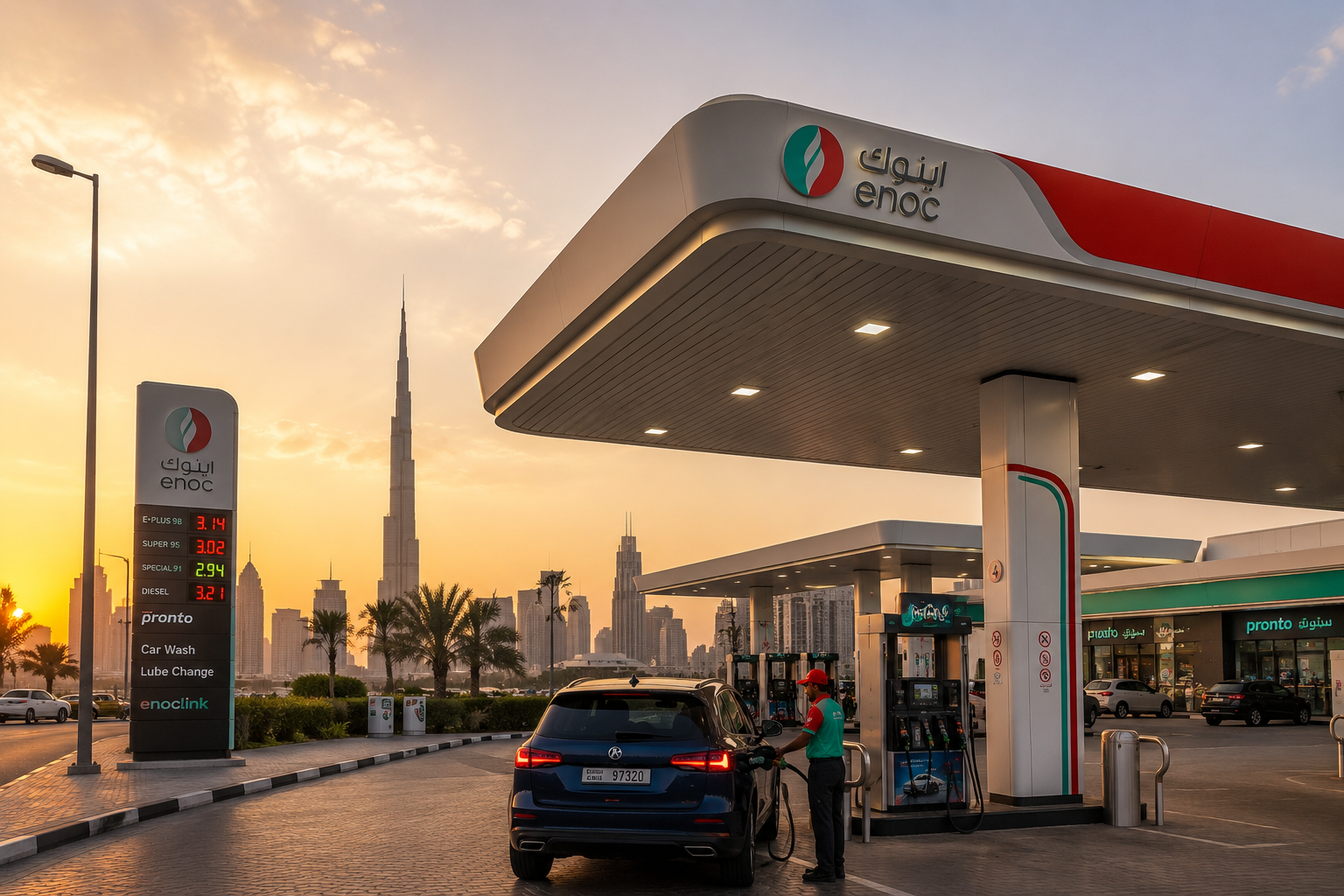
What just happened in the oil market
Global oil prices jumped sharply this week after reports emerged of Iranian missile strikes on two UAE tankers operating in the southern shipping lane of the Strait of Hormuz. Brent crude climbed above 85 dollars a barrel, while US benchmark West Texas Intermediate rose past 80 dollars, extending a rally of roughly 12 percent since the previous Friday.
The move is a sharp reversal from the calmer mood that had pushed Brent down into the low 70s after a US-Iran ceasefire framework agreed in June had restored some confidence in Gulf energy supplies. The renewed attacks reignited concerns over the security of a corridor that carries around 20 percent of the world's seaborne oil.
Why one bad week does not automatically mean higher pump prices
The UAE sets fuel prices monthly, using the previous month's average international oil price rather than reacting to daily swings. That mechanism matters here: a few days of elevated crude prices, on their own, are unlikely to move next month's petrol price much. What matters is whether Brent stays elevated over several weeks.
If oil retreats back toward the mid 70s range, the impact on the next fuel price review should be limited, and July's fuel price cut, the first in four months, could still be followed by stable or slightly lower prices. If Brent instead holds above 85 dollars for an extended stretch, the higher monthly average would reduce room for further cuts, or even create upward pressure on the next revision.
| Forecaster | Q3 2026 outlook | Q4 2026 outlook |
|---|---|---|
| US Energy Information Administration | Below $80 | Around $70 by year-end |
| Goldman Sachs | Not specified | Lowered to $80 (from $90) |
| Morgan Stanley | $90 | $80 |
| Citi | $75 | $70 |
What analysts are watching
Commodities strategists at ING have flagged that markets may be pricing in too little geopolitical risk, warning of meaningful upside if the supply recovery in the Gulf proves slower than expected or if tensions re-escalate.
Stephen Innes of SPI Asset Management noted that the physical oil system has proved more resilient than initially feared, since the market has kept functioning through pipeline alternatives, inventory drawdowns, and strategic reserve releases rather than a full recovery in Gulf shipping. He pointed out that Hormuz does not need to run at full capacity for supply to hold, since roughly 70 percent traffic combined with those alternatives can keep the market stable.
Four things that will decide the next fuel price review
- Whether Brent crude stays above 85 dollars or falls back toward 70 to 75 dollars.
- The security situation in the Strait of Hormuz and wider Gulf shipping lanes.
- Whether OPEC+ continues raising production as planned.
- Progress in diplomatic efforts between the United States and Iran.
Dubai's wider energy sector is already adjusting to this kind of supply uncertainty on other fronts. ENOC's recent move to secure sustainable aviation fuel supply from Central Asia is one example of UAE energy firms building supply chain resilience well beyond the monthly pump price debate.
The UAE's monthly, market-linked pricing system means short-term spikes rarely move pump prices on their own. The real signal to watch is whether Brent crude holds above 85 dollars for several weeks, not the daily headlines out of the Gulf.