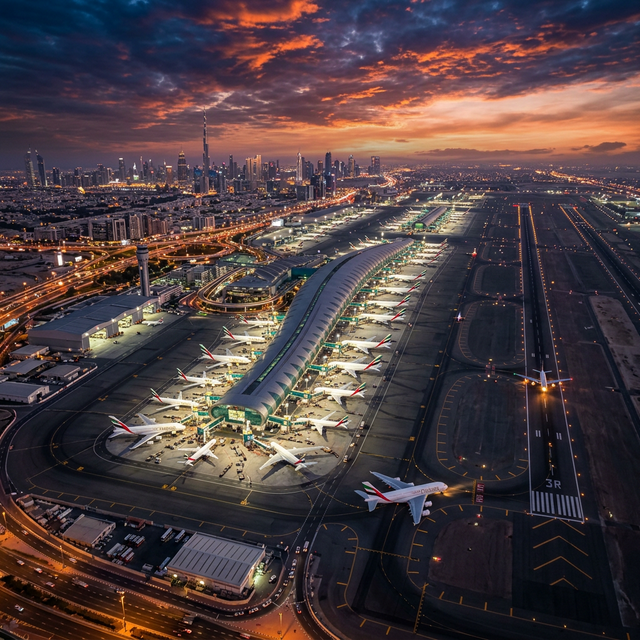
The United Arab Emirates has begun cautiously resuming a limited number of flights, offering a partial reprieve to hundreds of thousands of travellers stranded across the region following the outbreak of the US-Israeli military campaign against Iran.
Dubai Airport Authorises 'Small Number' of Flights
Dubai's airport authority confirmed on Monday that it had authorised a "small number" of flights to operate from both Dubai International Airport (DXB) — the world's busiest hub for international passengers — and Dubai World Central (DWC). The authority urged travellers not to make any travel plans unless they had been directly contacted by their airline with a confirmed departure time.
Emirates, the Dubai-based carrier, announced the resumption of a "limited" number of services on Monday evening, prioritising customers with earlier bookings. At least two Emirates flights that departed from Dubai successfully landed in Mumbai and Chennai, India, in the early hours of Tuesday morning, according to flight tracking service Flightradar24.
Etihad Operations Remain Largely Suspended
Abu Dhabi's Etihad Airways stated that commercial flights would remain suspended until Wednesday, though some "repositioning, cargo, and repatriation flights" could take place subject to operational and safety approvals. Despite this, Flightradar24 data showed at least 16 Etihad flights departing Abu Dhabi on Monday to destinations including London, Amsterdam, Moscow, and Riyadh.
The situation remained volatile into Tuesday morning, with two Etihad flights bound for Abu Dhabi diverted to Muscat, Oman, and an Emirates flight heading from Mumbai back to Dubai turning around mid-route, underscoring the highly fluid operational environment.
Over 11,000 Flights Cancelled Across the Region
The scale of disruption is staggering. Countries including Iraq, Jordan, Qatar, and Bahrain have closed their airspace in response to US-Israeli strikes on Iran and Tehran's retaliatory attacks on regional US allies, bringing air travel across the Middle East to a near-complete halt.
According to aviation data firm Cirium, more than 11,000 flights into and out of the region have been cancelled since the conflict began on Saturday. The knock-on effects are being felt globally, as some of the world's most critical east-west air corridors pass directly through the Gulf.
"An Iran-conflict-driven disruption is typically more geographically concentrated, but it can still be severe, because it affects some of the world's most important east-west corridors and creates rapid knock-on effects," said Tony Stanton, Consultant Director of Strategic Air, an Australian aviation consultancy, speaking to Al Jazeera.
European Governments Plan Evacuations
With commercial options limited, several governments are taking matters into their own hands. Germany's Federal Minister for Foreign Affairs, Johann Wadephul, announced on Monday that Berlin would dispatch chartered aircraft to Saudi Arabia and Oman to evacuate "particularly vulnerable" German citizens unable to make their own way home.
Long-Term Impact on Aviation Could Be Significant
Aviation analysts are warning that if the conflict extends beyond a few weeks, the airline sector could face lasting structural changes. Insurers may raise war-risk premiums, regulators could restrict flight paths, and carriers may be forced to permanently reroute services away from the Gulf.
"At that point, you can see route maps 'reset' — some services suspended indefinitely, hubs losing connection banks, and traffic shifting to alternative routings, or alternative hubs, that are perceived as lower-risk and more reliable," Stanton warned.
For now, Dubai's aviation authorities and airlines are navigating the crisis hour by hour. Passengers across the region are advised to monitor official airline communications closely and avoid travelling to airports without a confirmed booking.